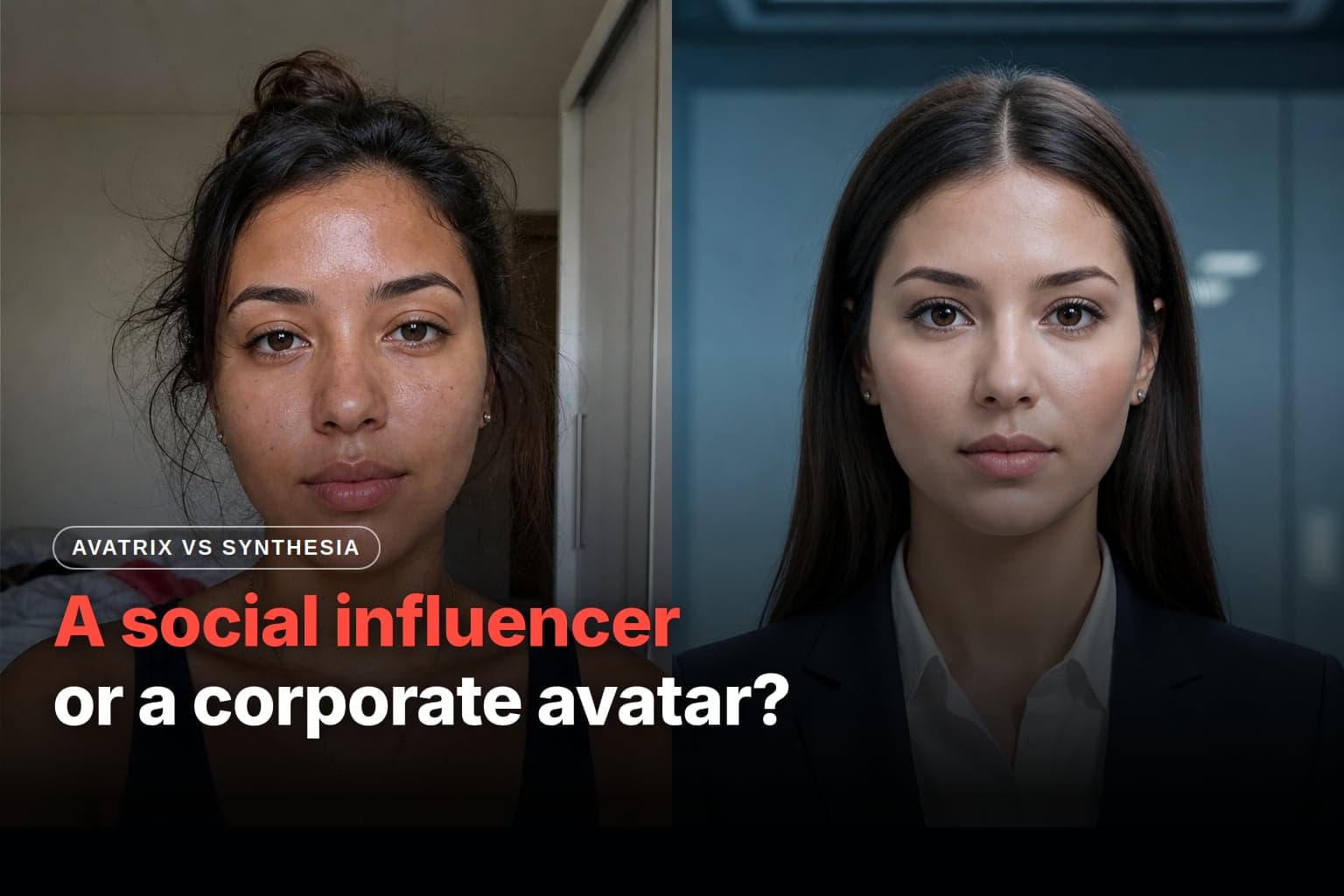
These two don't even compete for the same job. Synthesia is the leader in AI video for companies: HR, onboarding, compliance, an internal team watching an avatar present a training module. It's a first-rate corporate platform, built for businesses, not for social media creators. If what you make is an influencer who posts to the feed, Avatrix was built for exactly that path, and Synthesia sits in the category next door.
There's one thing that pinches creators: Synthesia's moderation rejects videos without saying why. It's the strict layer a corporate platform needs to serve large companies, but from the outside it turns into a "your video was declined" with no reason given, and in some reported cases, a canceled account. For a company team making internal material, that rigor is expected. For anyone who depends on uploading piece after piece, it's a brake that hits without warning. The Synthesia data in this article comes from the company's public pages, viewed in June 2026, with prices checked again on October 29, 2026.
Avatrix or Synthesia: which should you choose?
It comes down to one question: are you making video for a company or content for social? Someone recording onboarding for an internal team is playing one game. Someone building an influencer to post and grow on the feed is playing a completely different one. Synthesia and Avatrix live at opposite ends of that line, and each was built for one of them.
Choose Avatrix if your work is an AI influencer, social content, UGC for ads, or persona photos with the same face in every piece. You get more than 15 tools in one account, from photo to video, with the interface in English, Spanish or Portuguese.
Choose Synthesia if you need to turn a script or document into a corporate training video: an avatar presenting an onboarding module, HR material, compliance content for an internal team. It's the global standard for that use, with the enterprise features that world demands.
In one sentence: Synthesia is the avatar that presents the company's internal training; Avatrix is where you build an influencer who stays yours, post after post.
Synthesia is the benchmark for corporate video, not creator content
This is the point that decides everything, and it comes before any price comparison. Synthesia's stated mission is to change how companies train, onboard and upskill employees with AI. The whole product grew out of that: training, L&D, onboarding, HR, internal sales. More than 50,000 teams use it, and a large share of the Fortune 100 are customers, a number that tells you exactly who's on the other side of the screen.
Look at what shows up on Synthesia's feature and use-case pages: SCORM export for training platforms, single sign-on, compliance certifications, analytics on who watched a video to the end. That's the kit of a large HR tool. The product was designed for that audience: the company that needs to train teams at scale.
Synthesia generates plenty, including cinematic B-roll and social clips through its AI Playground. The point isn't capability, it's focus. Everything in the tool revolves around company video, with corporate stock avatars at the center. For a creator, that means using a training platform to try to make something it was never designed to deliver.
Avatrix goes the opposite way. It was built for people who create AI influencers: persona photos with a fixed face, motion video, the influencer holding the product, and short vertical clips for Reels and TikTok. It's creator-first from the very first screen, rather than company video adapted for creators.
| Dimension | Avatrix | Synthesia |
|---|---|---|
| Built for | Social creators, AI influencers, UGC | Companies: training, L&D, HR, compliance |
| Vertical creator video (product in hand) | Core focus | Corporate-first, geared to institutional content |
| LMS features (SCORM, SSO, compliance) | Out of scope | Yes |
| Same persistent face in every piece | Yes, it's the core use case | Personal Avatar (from Starter) |
Synthesia's moderation rejects videos without saying why
This is the second thing that catches creators off guard, and it's worth knowing before you subscribe. Synthesia serves large companies, and to do that it keeps a strict approval layer on top of every piece. For a Fortune 100 company's internal material, that makes complete sense: the compliance team wants exactly that control.
Seen from the creator's side, though, that layer becomes something else. There are reports in reviews and user forums of videos blocked without a clear explanation and, in some cases, of suspended accounts. You produce the piece, upload it, and it comes back rejected, with no word on what needs to change for it to pass. If you make one video a month, you won't feel it. If you need to upload piece after piece to keep a profile fed, you'll feel it every day.
At Avatrix there's no corporate moderation layer deciding, without explanation, what can go up. The platform was built for creators producing at volume: you generate, review and publish at your own pace, without a company compliance layer stalling the piece halfway.
| Dimension | Avatrix | Synthesia |
|---|---|---|
| Moderation | Built for creators producing at volume | Strict corporate layer over every piece |
| Rejected video | — | Reports of rejection with no reason given |
| Risk of account cancellation | — | Reported by users |
Price: both charge in dollars, but Synthesia's credits vanish at the end of each cycle
Currency doesn't separate these two: Synthesia and Avatrix both bill in US dollars. What separates them is what happens to what you paid for when you don't use it, and what that money actually buys.
Synthesia's plans, as listed on its official page on October 29, 2026: a free tier called Basic, with 10 minutes of video per month, 9 stock avatars and a watermark; Starter at $19 per month on monthly billing ($9 for the first month, $14 per month billed annually), with 125+ stock avatars, 3 personal avatars and up to about 12 minutes of video per month on top of the free allowance; Pro at $89 per month on monthly billing ($49 for the first month, $59 per month billed annually), with 180+ stock avatars, 5 personal avatars and up to about 60 minutes per month on top of the free allowance; and Enterprise with custom pricing. All in US dollars.
And there's a detail that affects how much of your payment you actually get to use: on Synthesia, minutes reset at the start of every billing period. Whatever's left over from one cycle doesn't carry into the next; it evaporates. If you produce in bursts one month and slow down the next, you lose whatever sat idle.
Avatrix starts from a different place. There are monthly plans in dollars, paid by card, plus extra credit packs you pay for once, also by card and with no subscription. In practice, an image runs about 6 credits and a video around 24. And credits from those packs don't expire: the balance stays there until you use it, unlike Synthesia's minutes, which disappear when the cycle turns over. Current prices are on the pricing page.
| Dimension | Avatrix | Synthesia |
|---|---|---|
| Currency | US dollars, by card | US dollars |
| Entry without a recurring plan | One-time credit pack, never expires (no free trial) | Free plan (10 min/month, 9 avatars) |
| Credits carry over month to month | Yes: extra pack credits don't expire | No: minutes reset every cycle |
| What your money buys | 15+ tools: photos, UGC video, Motion Control, video editor | Avatar video minutes |
Sources: Synthesia plans checked at synthesia.io/pricing on October 29, 2026. Prices are in US dollars.
How much does Synthesia really cost?
The list price is clear; what you actually pay per video depends on how much you use each cycle. Synthesia charges in video minutes, and your plan sets the ceiling: about 12 minutes a month on Starter and about 60 on Pro, on top of the free allowance. Whatever you don't use in the period doesn't roll over.
The free Basic plan exists and you can try it without a card, but with 10 minutes a month and 9 avatars it's for taking a look, not for real production. The first paid plan that's actually usable, Starter, costs $19 per month on monthly billing ($9 for the first month, $14 per month billed annually). Add the minute reset every cycle and the bill gets less predictable than it looks from the outside: a slow month costs the same as a busy one.
With Avatrix, the math is direct: you pay in dollars by card, either on a monthly plan or with one-time extra credit packs. There's no free trial; if you want to try it before subscribing, you can buy a pack, and those credits have no expiration date, so a quiet month doesn't burn your balance. If you create in bursts, that alone shortens the decision before you compare feature by feature.
Corporate stock avatar versus your own influencer
Each tool's purpose is clearest here. Synthesia has an avatar library that grows with the plan (9 on Basic, 125+ on Starter, 180+ on Pro), plus Personal Avatars, which create a persistent avatar from a photo of you (3 on Starter, 5 on Pro). It's a solid catalog for company video: presentable avatars, several looks, a corporate tone.
But a corporate stock avatar is the opposite of what makes a creator persona work. People creating an AI influencer don't want a generic face that other companies also drop into a training video. They want THEIR influencer: the same face, the same person, in every photo and every video, to build recognition and grow a persona over time. It's the difference between "someone showed up in a company video" and "that's the influencer from my profile." When you're building a profile people follow, the face that never changes is what lets the audience recognize whose it is.
Then there's format. Synthesia generates video, B-roll and social clips, but the whole operation is corporate-first: the focus is institutional content, not the vertical influencer video with the product in hand for TikTok Shop and Reels. Avatrix is designed for exactly that creator format. It runs image models such as Reference and Creative and video models such as AI Video 1 and AI Video 7, covering everything from persona photos with the same face to motion video, trend dances, product-in-hand shots and vertical clips. It's the full influencer, from image to video, built for the feed.
| Feature | Avatrix | Synthesia |
|---|---|---|
| Same face in every piece | Yes: the persona is yours and persistent | Personal Avatar (from Starter) |
| Product focus | AI influencers for social media | Company video for training |
| Vertical creator video, product in hand, TikTok Shop | Core focus | Corporate-first, geared to institutional content |
| Moderation | Built for creators producing at volume | Corporate layer that can block without explanation |
Language: one account in English, Spanish and Portuguese
Synthesia was built in English for the global corporate market, and it has localized versions of its site, such as Portuguese and Spanish. Whatever language you read it in, the workflow is still that of a company tool: modules, training, an avatar presenting a topic.
Avatrix is a Brazilian platform that works in three languages: the interface is available in English, Spanish and Portuguese, and the voice library has voices in all three, plus voice cloning. If you run one persona for a US audience and another for Latin America or Brazil, it's the same account and the same workflow.
That matters more than it seems. An AI influencer who talks to camera needs a voice that fits the persona and the audience's language, as much as a face that doesn't change. With the voice, the face and the video in the same account, the persona stays one consistent character across photos, videos and audio. For a creator who just wants to build a persona and start posting, that's one less hurdle on every screen.
What Synthesia does better
There are three areas where Synthesia comes out ahead, and if one of them is at the center of your work, it's the obvious pick.
First, corporate training video. To turn a script or document into an avatar video presenting an onboarding, L&D or HR module, Synthesia was built for exactly that. It's the company's stated mission, with more than 50,000 teams and a large share of the Fortune 100 using it, and the whole tool revolves around that use.
Second, enterprise and LMS features. SCORM export for training platforms, single sign-on and compliance certifications. If your operation is a company whose IT team requires that kind of thing, Synthesia has what large organizations around the world use. That's not Avatrix's territory.
Third, corporate reputation and a large avatar library. A 4.7 out of 5 rating on G2 from more than 2,300 reviews, and a catalog that goes from 9 to more than 180 stock avatars depending on the plan, with a free tier you can try without a card. If you want a presentable avatar reading company material, the variety and the track record are there.
If one of these three is the core of what you do, the recommendation is simple: stick with Synthesia.
What Avatrix does better
On the other side, Avatrix stands out right where it hurts for people producing content. Not that it wins everywhere: it wins on the ground where creators actually spend their day.
First, the whole persona in one account, with credits that don't expire. More than 15 tools: photos with the same face, UGC video with the influencer talking to camera, Motion Control to copy a dance or movement from a reference video, an AI chat that generates photos and videos of your character, Workflow (a node canvas) and a video editor. Credits from extra packs don't expire, so your balance doesn't vanish at the turn of the month the way Synthesia's minutes do.
Second, an influencer who stays yours, with nobody blocking the piece. Avatrix keeps the same face in every piece; it's the path to building the complete influencer, from photo to video. Instead of a corporate stock avatar, you build a recognizable persona the audience associates with your profile over time. And there's no company moderation deciding, without explanation, what goes up.
Third, the creator format, not the company format. Reference, Creative, AI Video 1 and AI Video 7 deliver realistic photos, motion video, trend dances, product-in-hand shots and vertical clips: the content people post on TikTok and Reels. Avatrix is designed for that creator use, while Synthesia is corporate-first.
Verdict: products built for different worlds
There's no "best of all": there's the right one for what you do, and here the two products were born for different worlds. Synthesia is the leader in corporate training video, with the strict moderation an enterprise platform needs. Avatrix is AI influencers for social media. The question isn't "which one wins," it's "what do you produce."
If you need an avatar presenting internal training, with enterprise and LMS features, Synthesia handles it better and was built for it; and the moderation that slows creators down is, in that setting, exactly what the compliance team wants. But if you create an influencer to post on social media, monetize a persona and grow on the feed, without having pieces rejected for no reason halfway through, Synthesia wasn't designed for that. Avatrix was.
For social media creators, the scale tips toward Avatrix, and four things tip it: the focus, the toolset, the face that never changes, and the absence of a corporate layer stalling your content. Having photos, UGC video, Motion Control and models like AI Video 1 and AI Video 7 in one account, with extra credits that don't expire, saves you from jumping between tools, and keeping the same face in every piece is what makes your audience recognize your influencer. Plenty of people are doing exactly that on the platform right now.
Frequently asked questions
Is Synthesia good and reliable?
Synthesia is a real platform and a leader in its segment: 4.7 out of 5 on G2 from more than 2,300 reviews, more than 50,000 teams, and a large share of the Fortune 100 among its customers. For corporate training video, it's a global benchmark. What catches creators off guard isn't quality, it's the corporate focus and the strict moderation that can block a video without explanation. For people creating for social media, Avatrix avoids both of those frictions.
Can you use Synthesia to create an AI influencer or social content?
It's not what it's built for. Synthesia is corporate-first: training, onboarding and HR video, with corporate stock avatars at the center. It generates video, B-roll and social clips, but the whole operation is designed for companies, not creators, and its moderation can block a piece without explanation. Avatrix was built for AI influencers with a persistent face, product-in-hand content and vertical video for social.
Which languages do Synthesia and Avatrix work in?
Synthesia was built in English for the global corporate market and has localized versions of its site, such as Portuguese and Spanish. Avatrix is a Brazilian platform with the interface in English, Spanish and Portuguese, and a voice library with voices in those three languages, plus voice cloning.
How much does Synthesia cost?
Starter costs $19 per month on monthly billing ($14 billed annually) and Pro $89 ($59 billed annually), plus the free Basic plan with 10 minutes per month (official page, October 29, 2026). Keep in mind that minutes reset every cycle. Avatrix also bills in dollars, with a monthly plan or one-time extra credit packs by card whose credits don't expire. There's no free trial, and current prices are on its pricing page.
Get to know Avatrix
If what you make is AI influencers, UGC and social content, in your audience's language and without company moderation blocking your work, it's worth taking a close look at the platform before you decide.