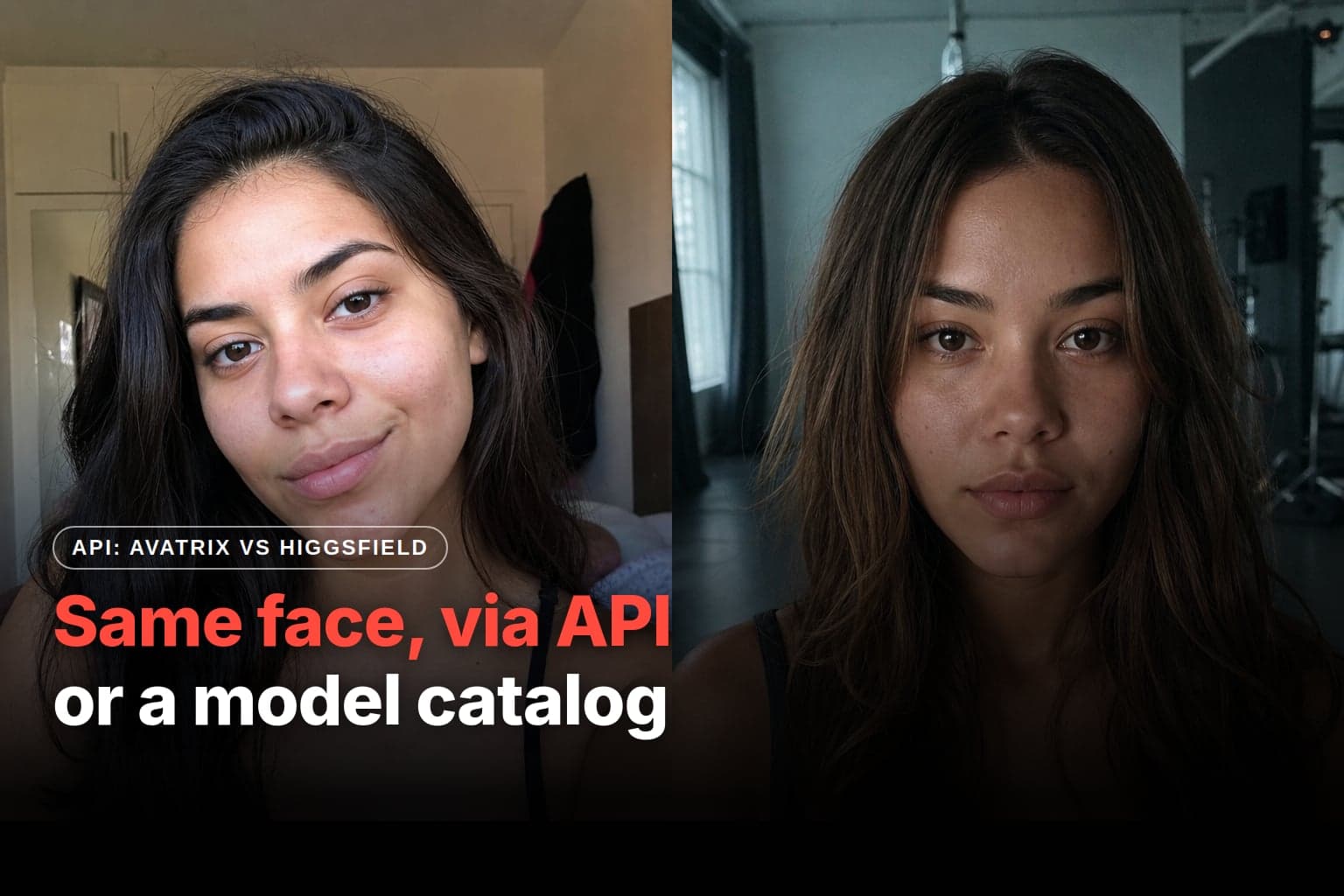
Avatrix and Higgsfield both generate AI influencers through an API, and in 2026 the difference isn't capability: it's focus. Both bill in US dollars. Avatrix gives you a token instantly, from your own account, on the same credits as the web app, and it's built for one job: an AI influencer with the same face across photos and UGC video. Higgsfield runs its Cloud API inside a global, English-language platform with a broad catalog of models (official site, June 2026). If you want to automate an influencer with a consistent face and keep the app and the API on one credit balance, Avatrix fits better. If you want a global catalog of models in one place, Higgsfield is strong. Under the hood, the Avatrix API runs the same engine as the web app: image models such as Reference and Creative, and video models such as AI Video 1 and AI Video 7.
Avatrix or Higgsfield: which API should you use in 2026?
To automate an AI influencer with the same face, Avatrix fits better; to work across a global catalog of models, Higgsfield. One question settles most cases: is what you're automating an influencer, the same person across photos and UGC videos, and do you want the app and the API on a single credit balance? If yes, Avatrix removes friction right from the start.
Both generate a consistent influencer, images, and video through code, and both bill in dollars. What changes is the focus. Avatrix is built for the AI influencer, with more than 15 tools in one account; Higgsfield is a global, English-language platform with dozens of image and video models. That's the axis of this page: the API, the access, and how you pay.
If your question is about the product, meaning which one to use to build the influencer day to day by clicking through the app, the right place is the general Avatrix vs Higgsfield comparison. Here the focus is on whoever will integrate through code, automate a content pipeline, or plug it into a workflow.
Do both have an API? What does each one expose?
Yes. Avatrix has REST API v1 live at https://avatrix.io/api/v1 (you can check it by hitting avatrix.io/api/v1/health), and Higgsfield has its Cloud API inside its global platform (official site, June 2026). Both generate through code; the difference is in the focus and in how each path bills.
On Avatrix, you authenticate with an av_ token generated in your account and send the POST. The API exposes influencer, image, UGC video, creative video, and voice generation, plus image editing and character swap. Everything is asynchronous: the request comes back with a taskId, and you fetch the result by polling or by webhook. The engine is the same as the app, Reference and Creative for images, AI Video 1 and AI Video 7 for video, with 82% of generations completing successfully (Avatrix's own data, database snapshot from June 2026).
| What the API does | Avatrix | Higgsfield |
|---|---|---|
| Generation per request | REST v1 (avatrix.io/api/v1), av_ token | Cloud API on the global platform |
| Influencer, image, video, voice | Yes, direct endpoints | Yes, within the model catalog |
| Response | Asynchronous (taskId + webhook) | Platform-defined, in English |
| Focus | AI influencer with the same face, UGC video | Broad catalog of image and video models |
To go through every Avatrix endpoint and field at your own pace, the complete API guide lays out the whole map, and the live docs are at avatrix.io/api/docs.
How much does each API cost?
Both bill in US dollars. The Avatrix API runs on the same credits as the web app; Higgsfield's is billed in dollars on its platform. What changes is how credits get spent and how you top up.
On Avatrix, the API isn't billed separately: it's the same credit as the web app. Measured in practice in June 2026, a persona image costs 10 credits, voice 1, and video between 40 and 56 per generation. Credits come from monthly plans in US dollars, paid by card, or from one-time extra credit packs, with no subscription, that never expire: you can load up a batch, run the pipeline, and top up only when you need to. There's no free trial, and plan prices are on /pricing.
On Higgsfield, billing is in US dollars (official site, June 2026), and its API platform lists a price per model (open.higgsfield.ai, checked October 29, 2026). With a catalog that broad, what your pipeline costs depends on which models you pick, so check the list before you build.
| API cost | Avatrix | Higgsfield |
|---|---|---|
| Currency | US dollars, by card | US dollars |
| How it's charged | Credits: 10 per image, 1 per voice, 40–56 per video | Price per model on the API platform |
| Where the API lives | Same account and credits as the web app | Its own API platform (open.higgsfield.ai) |
| Extra credits | One-time pack, no subscription, never expires | In US dollars |
Self-serve or enterprise: how do you get access?
On both, you get the key yourself: on Avatrix the token is self-serve and instant, and Higgsfield's API platform also hands out API keys when you sign up (open.higgsfield.ai, checked October 29, 2026). That's good news, because across much of the AI video market the API sits on a pricier tier or requires a contract, and sometimes you have to talk to sales before you get a key. For a creator or dev who just wants to test an integration over a weekend, that's a barrier before the first line of code.
On Avatrix, you create the account, go to avatrix.io/account/tokens, pick the token's scopes, and send the first request, with no sales call and no contract. The token starts with av_ and identifies your account on every call. What you do need is credits, since there's no free trial.
| API access | Avatrix | Higgsfield |
|---|---|---|
| How you get it | Self-serve token, instantly | API key on open.higgsfield.ai |
| Talk to sales | No | No, the key is self-serve |
| How you pay | Web app credits, in US dollars by card | US dollars, by model |
| First request | In minutes, with curl | From the API platform |
Do both keep the same persona through the API?
Yes. Both hold the same face across generations, which is what separates an influencer (the same person in a thousand photos) from an image that changes faces every time. The difference, once again, isn't capability: it's focus.
On Avatrix, you lock the persona from reference photos and reuse that face in every API call. On Higgsfield, facial identity is locked by a feature of the platform itself (official site, June 2026). Both solve the same problem: keeping the influencer recognizable from one post to the next.
The step by step for building the persona from scratch, with reference and prompt, is in how to create a faceless AI influencer. The API just automates what that workflow does by hand.
What Higgsfield does better
Here's the honest part: there are fronts where Higgsfield is ahead, and hiding that would be misleading. When one of them is what decides it for you, go with Higgsfield without a second thought.
It starts with the model catalog. It brings dozens of image and video models together in a single interface, in English: great if you want to test and compare option after option without switching tools all the time.
There's also the scale of the operation. More than 25 million users and 850 million generations, by the company's own count, with a valuation above one billion dollars (higgsfield.ai/about, June 2026). If you're looking for a mature platform with heavy backing, you'll find that depth there.
And there's international reach. If you work in English for a global audience, a global platform already plays on your home field, from the interface to support. For anyone operating that way, it counts in its favor right away.
When one of these points is the core of what you do, there's not much to argue about: Higgsfield delivers.
What Avatrix does better
On the Avatrix side, the advantage shows up exactly where it matters for anyone automating an AI influencer. Again, it isn't a better feature: it's focus, credits, and how you plug it in.
First, built for the AI influencer. Avatrix was born to create hyper-realistic virtual influencers with the same face in every photo and video, and it brings more than 15 tools into one account: UGC video (the influencer talking to camera, product reviews), Motion Transfer to copy dances and moves from a reference video, an AI chat that generates photos and videos of the character, Workflow (a node canvas), and a video editor. The API takes that same workflow into your code or your n8n.
Second, one credit balance for the app and the API. The API isn't billed separately: the token spends the same credits as the web app, in US dollars. Extra credit packs are a one-time card payment, with no subscription, and they never expire: you can load credits for an integration and spend them at your own pace.
Third, ready for agents and voice. Beyond the REST API, there's an MCP connector for Claude and ChatGPT, so an agent can generate with your account. And the voice library has English, Spanish, and Portuguese voices, plus voice cloning. You trigger generation through the API and build the pipeline that makes sense for your case.
Verdict: focus, credits, and the way in decide
Neither one is "the best at everything": each wins on its own ground. And the ground here isn't capability, because both generate AI influencers through an API, and it isn't currency, because both bill in US dollars. For the creator or dev choosing between them, three things settle it: the focus, the credits, and the way in.
A platform built for the AI influencer, with the same face in photos and video, UGC video, and more than 15 tools in one account; the same credits in the app and the API, with one-time packs that never expire; and a self-serve REST API plus an MCP connector for Claude and ChatGPT. If that's what you need to automate, the needle points to Avatrix. It's the same engine more than 5,000 creators already run inside the web app, now callable from code.
Higgsfield is strong for a well-defined profile: someone who wants the global model catalog of a huge platform and plans to test model after model. For that creator, it more than delivers. And for the full product comparison (interface, pricing, and on-screen workflow), the general Avatrix vs Higgsfield comparison covers the rest.
Frequently asked questions
Does Higgsfield have an API?
Yes. According to its official site, checked in June 2026, Higgsfield offers its Cloud API inside its global platform, billed in US dollars. Avatrix also has a REST API, v1, with a self-serve token and the same credits as the web app. Both can generate AI influencers through code; what changes is the focus.
How much does the Higgsfield API cost?
Higgsfield bills in US dollars, and its API platform lists a price per model, so the cost depends on which models you use; check the current list before you build. The Avatrix API runs on the web app's credits: 10 per image, 1 per voice, and 40 to 56 per video, measured in June 2026. Avatrix plans are monthly, in US dollars, and extra credit packs never expire.
Do I need an expensive plan to use the Avatrix API?
No. You generate the token yourself, instantly, at avatrix.io/account/tokens, without talking to sales. It's the same credit as the web app, just triggered by code. Many AI tools only open their API on a higher tier or under a contract. There's no free trial, though: you need credits from a plan or a pack.
Can the Avatrix API do everything Higgsfield's can?
For generating influencers, images, video, and voice, yes: it's the same engine as the web app, with image models such as Reference and Creative, and video models such as AI Video 1 and AI Video 7. Higgsfield is a bigger global platform, with a broader catalog of models in a single dashboard. Both have the capability to generate.
Which API should I choose to automate AI influencer content?
Avatrix, if what you're automating is an influencer with the same face: an instant self-serve token, the same credits as the web app, one-time packs that never expire, and an MCP connector for Claude and ChatGPT. Higgsfield fits better if you want a global catalog of models on one platform.
Generate your first influencer through the API
The Avatrix REST API is live, built in Brazil, and runs the same engine as the web app. You create an account, generate a token in seconds, and send your first persona with a curl, with no sales call. The full docs, with every endpoint, are at avatrix.io/api/docs. To get going now:
Frequently asked questions
Yes. According to its official site, checked in June 2026, Higgsfield offers its Cloud API inside its global platform, billed in US dollars. Avatrix also has a REST API, v1, with a self-serve token and the same credits as the web app. Both can generate AI influencers through code; what changes is the focus.
Higgsfield bills in US dollars, and its API platform lists a price per model, so the cost depends on which models you use; check the current list before you build. The Avatrix API runs on the web app's credits: 10 per image, 1 per voice, and 40 to 56 per video, measured in June 2026. Avatrix plans are monthly, in US dollars, and extra credit packs never expire.
No. You generate the token yourself, instantly, at avatrix.io/account/tokens, without talking to sales. It's the same credit as the web app, just triggered by code. Many AI tools only open their API on a higher tier or under a contract. There's no free trial, though: you need credits from a plan or a pack.
For generating influencers, images, video, and voice, yes: it's the same engine as the web app, with image models such as Reference and Creative, and video models such as AI Video 1 and AI Video 7. Higgsfield is a bigger global platform, with a broader catalog of models in a single dashboard. Both have the capability to generate.
Avatrix, if what you're automating is an influencer with the same face: an instant self-serve token, the same credits as the web app, one-time packs that never expire, and an MCP connector for Claude and ChatGPT. Higgsfield fits better if you want a global catalog of models on one platform.