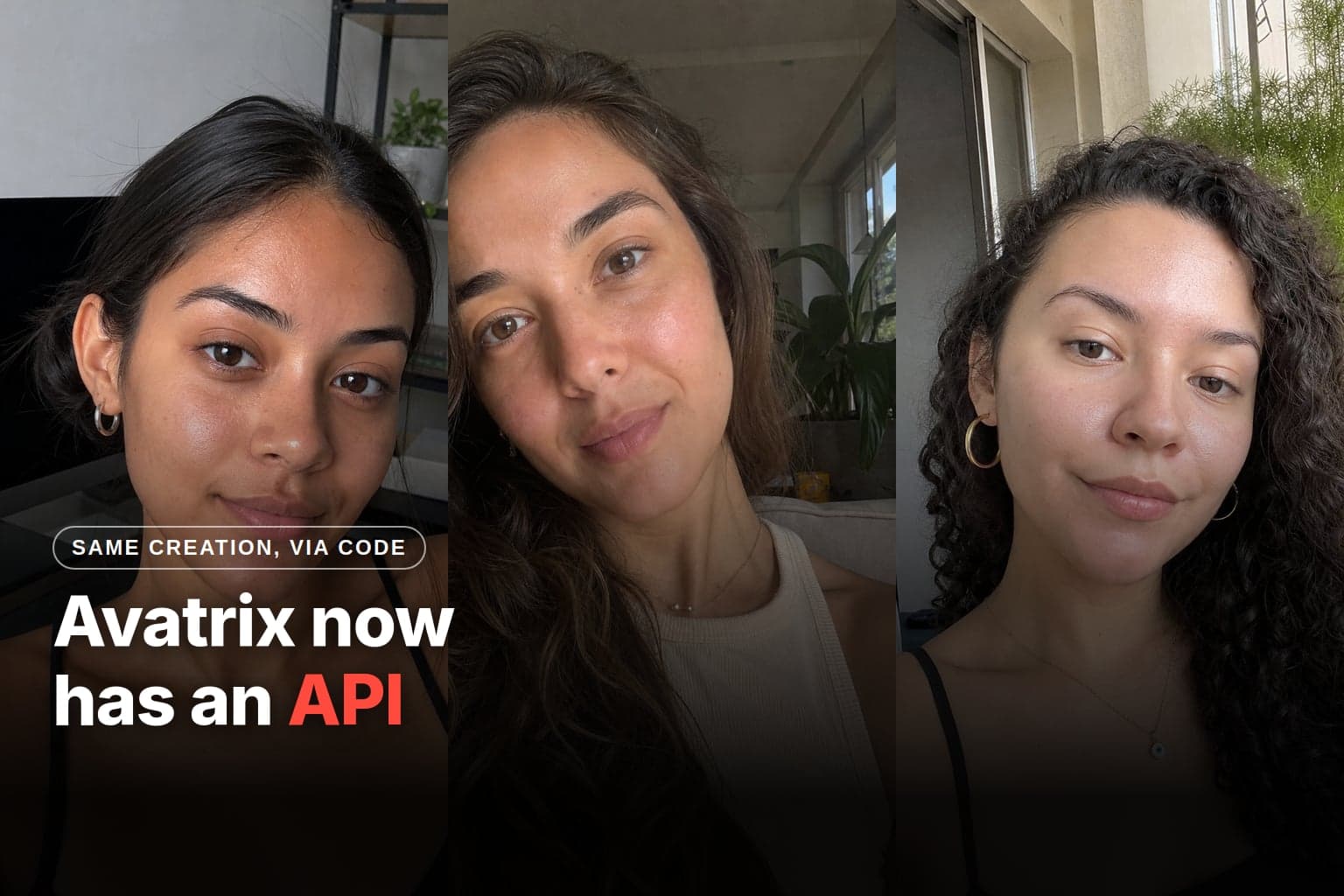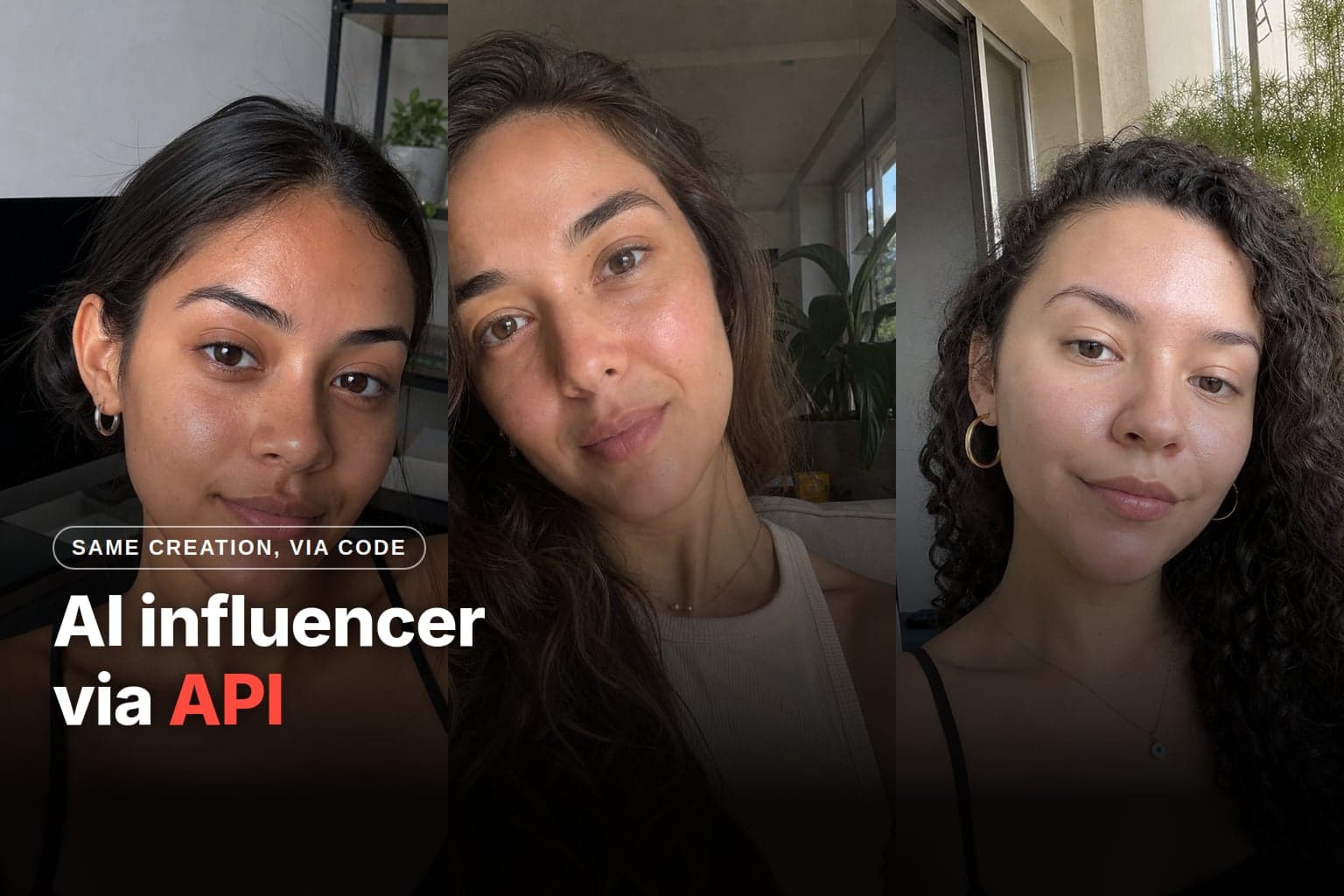
Yes, you can generate a complete AI influencer via API, without opening the site or clicking anything. You send a POST to https://avatrix.io/api/v1/generate/influencer with a token, get back a tracking ID, and pick up the finished persona seconds later. Under the hood it runs the same engine that more than 5,000 creators already use inside the platform, with 82% of generations completing successfully (Avatrix's own data, database snapshot from June 2026). This post is the direct route: the first request, what it costs in credits, and why getting access here works differently from most tools in the niche.
How do you generate an AI influencer via API? (the direct route)
You generate an AI influencer via API in three steps: create a token in your account, send a POST to /generate/influencer with that token, and fetch the result using the taskId. There's no install and no required SDK: it's plain HTTP, and it works with curl, with the language you already use, or with an HTTP node in n8n.
The difference from the site isn't quality, it's control. In the app you create one persona at a time, by hand. Through the API you fire off dozens, whenever you want, inside your own workflow. That's what separates "creating an influencer" from "having an influencer pipeline that runs on its own."
And it's not a brand-new product nobody has tested. There are 5,674 creators on the platform and more than 5,000 pieces of content generated since launch (Avatrix database snapshot, June 2026). The API simply opens up, request by request, the same machine those creators already run in the app.
Quickstart: your first request in 3 lines
The shortest path is to generate the token, send the POST and check the taskId: three steps, no detours. The access token (or PAT) is the key that identifies your account on every call.
Step 1: generate the token. In your account, at avatrix.io/account/tokens, create a token and choose its scopes (for example generate:image, which covers persona generation). It starts with av_ and is shown only once, so copy it and store it somewhere safe.
Step 2: send the generation. A POST to /generate/influencer with the token and the persona sheet, using the same fields as the site's influencer creator: type, gender, age (18 to 60), ethnicity, eyes, skin, body, arms, legs, hair and style. Field names and values are in Portuguese, as in the API. Avatrix picks the image model, so it doesn't go in the request:
curl -X POST https://avatrix.io/api/v1/generate/influencer \
  -H "Authorization: Bearer av_YOUR_TOKEN_HERE" \
  -H "Content-Type: application/json" \
  -d '{
    "name": "Lia",
    "tipo": "humano",
    "genero": "feminino",
    "idade": 24,
    "etnia": "mestico",
    "olhos": "olhos_castanho_escuro",
    "pele": "pele_sardas",
    "corpo": "corpo_normal",
    "bracos": "bracos_normais",
    "pernas": "pernas_normais",
    "cabelo": "cabelo_liso_longo",
    "estilo": "estilo_hiper"
  }'
The accepted values for each field are in the endpoint documentation. A value outside the list returns a VALIDATION_ERROR that already lists the right ones.
The response comes back immediately, but it isn't the image; it's the task's tracking ID:
{ "success": true, "data": { "taskId": "<task-id>", "status": "queued" } }Step 3: get the result. With the taskId, check the task until it's ready:
curl https://avatrix.io/api/v1/tasks/YOUR_TASK_ID \
  -H "Authorization: Bearer av_YOUR_TOKEN_HERE"
When status turns completed, you get the resultUrl with the persona photo. That's the cycle for any generation in the API. To go through every endpoint and field at your own pace, the complete Avatrix API guide lays out the whole map.
Why doesn't the response arrive right away? (taskId, polling and webhook)
Generation is asynchronous: the request returns a 202 with a taskId and status: queued, not the image. That makes sense: generating a persona or a video takes time, and holding the connection open while you wait would be fragile. Instead, the API hands you a tracking ID and keeps working.
From there, you have two options. Polling means calling GET /tasks/:id every so often: status moves from pending to processing and finally completed, and then the resultUrl arrives. It's simple to set up and good for getting started.
A webhook is cleaner at volume. You pass a callbackUrl when you create the generation, and when the persona is ready, Avatrix sends a POST to your endpoint with the link. You don't have to keep asking "is it done yet?": the result just shows up. The most robust setup is to use the webhook and keep polling as a safety net.
What else can the API generate besides the influencer?
Beyond the persona, the API generates almost everything the platform does: standalone images, UGC video, creative video and voice, plus image editing and character swaps. Each token carries scopes, and the scope unlocks a group of endpoints. If you're only generating personas and photos, create a token with generate:image and you're set.
| What you want to generate | Endpoint | Token scope |
|---|---|---|
| AI influencer (persona) | POST /generate/influencer | generate:image |
| Standalone image | POST /generate/image | generate:image |
| Edit or combine images | POST /generate/image-edit | generate:image |
| UGC video | POST /generate/video-ugc | generate:video |
| Creative video | POST /generate/video-creative | generate:video |
| Voice | POST /generate/voice | generate:audio |
| Check generation status | GET /tasks/:id | read:tasks |
| Check credit balance | GET /credits | read:usage |
The engine behind it is the same as the app's: image models such as Reference and Creative, and video models such as AI Video 1 and AI Video 7. The full list, with each request body, lives in the official docs at avatrix.io/api/docs, the living source, always ahead of any blog post.
How much does it cost to generate an influencer via API (in credits)?
You pay in credits, the same way you do on the site; the API doesn't charge separately. Running the API ourselves in June 2026, we measured the real cost of each generation by watching the credits leave the balance:
| Generation | Measured cost (credits) |
|---|---|
| Persona image (Reference) | 10 |
| Character swap | 10 |
| Edit or combine images | 17 |
| Voice | 1 |
| Video | 40 to 56 |
Video varies because it depends on the model and the duration: from cheaper models to heavier ones, the math changes. Images hold steady at 10 credits, and voice is the cheapest at 1 credit per generation.
Credits come two ways: monthly plans in US dollars, paid by card, or extra credit packs you pay for once by card, with no subscription, and those credits don't expire. For automation, that matters: you can load up a batch, run the pipeline, and top up only when you need to, with no subscription setting the pace. If you want to buy credits through the API itself, the payment method available there today is Pix, Brazil's instant payment system; card purchases happen on the site. Current prices are on the pricing page.
Every competitor has an API: the difference is how you get in
The other tools in this niche have APIs too. What really changes is how you get access. In most of them, API access comes with a pricier plan or a contract. Arcads, for example, only unlocks the API on its Pro plan, priced on request: the public plans (Starter and Creator, in the $110 to $220 per month range) don't include the API, and to use it you have to talk to sales. Higgsfield has its Cloud API, billed in dollars; HeyGen and Synthesia offer API access through an enterprise contract.
At Avatrix, the door is self-serve. You create the account, generate the token on the spot at avatrix.io/account/tokens, and send your first request, with no plan worth hundreds of dollars to unlock and no sales call. You pay with the same credits as on the site, and credits from extra packs don't expire.
| Platform | Has an API? | Way in | Currency |
|---|---|---|---|
| Avatrix | Yes (REST v1) | Self-serve token, instant | US dollars, by card |
| Arcads | Yes | Pro plan only (price on request) | US dollars |
| Higgsfield | Yes (Cloud API) | Account + credits in dollars | US dollars |
| HeyGen / Synthesia | Yes | Enterprise contract | US dollars |
Source: competitors' billing model and API access from their official pages (arcads.ai, higgsfield.ai), checked in June 2026. Competitor prices change, so check the official page before you decide. For a full market comparison, see Avatrix vs Higgsfield.
How do you keep the same influencer face in every generation?
You keep the same face by locking the persona from reference photos and reusing that same face in every new API call. That's what separates a real influencer, the same person in a thousand photos, from a random image whose face changes with every generation.
In practice, you create the persona once, save the reference, and pass it in the following requests. That way /generate/image returns the same woman at the coffee shop, at the gym, in her bedroom, always with the face you locked. Without it, every photo would show a different person, and nobody follows an "influencer" whose face changes every week.
That's the key trick for creators who build a persona without showing their own face. The step-by-step for building the persona from scratch, with reference and prompt, is in how to create an AI influencer without showing your face; the API just automates what that workflow does by hand.
Can you use the API without coding?
Yes. Because the API is REST with a token, any tool that can make an HTTP call can generate with Avatrix, and n8n, Make and Zapier all can. You use the generic HTTP node, paste the URL https://avatrix.io/api/v1/generate/influencer, add the header Authorization: Bearer av_YOUR_TOKEN and the JSON body. The flow handles the rest: it fires the request, waits, and grabs the resultUrl.
To hook it up to an AI agent like Claude, the path underneath is the same. An assistant that can make HTTP calls can generate the persona inside the conversation: instead of opening the site and clicking, you ask "generate three variations of this influencer on a beach" and the agent fires the request. Avatrix also has an MCP connector for Claude and ChatGPT that packages these calls, and the complete API guide details the three usage profiles.
Frequently asked questions
Can you create an AI influencer via API?
Yes. You send a POST to https://avatrix.io/api/v1/generate/influencer with an av_ token in the header, and the API returns a taskId. The persona comes from the same engine that more than 5,000 creators already use inside the site, just triggered by code instead of the screen.
How much does it cost to generate an influencer via the API?
You pay in credits, same as on the site. Measured in practice in June 2026, a persona image costs 10 credits, a voice 1, and a video between 40 and 56 per generation. Credits come from monthly plans or from extra credit packs, which don't expire.
Do I need to know how to code to use the API?
To make the request directly, it helps to know basic HTTP. But you can use it without code: n8n, Make and Zapier have an HTTP node where you paste the URL, the token and the request body. You build the flow by dragging blocks, without writing a single line.
Does the API keep the same influencer face in every generation?
Yes. You lock the persona from reference photos and reuse that same face in every new generation. That's what separates an influencer (the same person in a thousand photos) from a random image whose face changes every time.
Is the Avatrix API self-serve, and how do I pay?
Yes. You create the account and generate the token instantly, without talking to anyone. You pay in credits, same as on the site: monthly plans in US dollars by card, or one-time extra credit packs by card that don't expire. Avatrix is a Brazilian platform, and buying credits through the API itself currently works only with Pix, Brazil's instant payment system; with a card, you buy on the site. Most AI video APIs only unlock access on a pricier plan or through a contract, which means talking to sales.
Generate your first influencer via API
The Avatrix REST API is live and runs the same engine that more than 5,000 creators already use. You create the account, generate a token in seconds, and fire off your first persona with a curl; after that, it's about building the pipeline that fits your workflow, in code, in n8n or in an agent.
The full docs, with every endpoint and field, are at avatrix.io/api/docs. To get started now:
Frequently asked questions
Yes. You send a POST to https://avatrix.io/api/v1/generate/influencer with an av_ token in the header, and the API returns a taskId. The persona comes from the same engine that more than 5,000 creators already use inside the site, just triggered by code.
You pay in credits, same as on the site. Measured in practice in June 2026, a persona image costs 10 credits, a voice 1, and a video between 40 and 56 per generation. Credits come from monthly plans or from extra credit packs, which don't expire.
To make the request directly, it helps to know basic HTTP. But you can use it without code: n8n, Make and Zapier have an HTTP node where you paste the URL, the token and the request body. You build the flow by dragging blocks, without writing a single line.
Yes. You lock the persona from reference photos and reuse that same face in every new generation. That's what separates an influencer (the same person in a thousand photos) from a random image whose face changes every time.
Yes. You create the account and generate the token instantly, without talking to anyone. You pay in credits, same as on the site: monthly plans in US dollars by card, or one-time extra credit packs by card that don't expire. Avatrix is a Brazilian platform, and buying credits through the API itself currently works only with Pix, Brazil's instant payment system; with a card, you buy on the site. Most AI video APIs only unlock access on a pricier plan or through a contract, which means talking to sales.