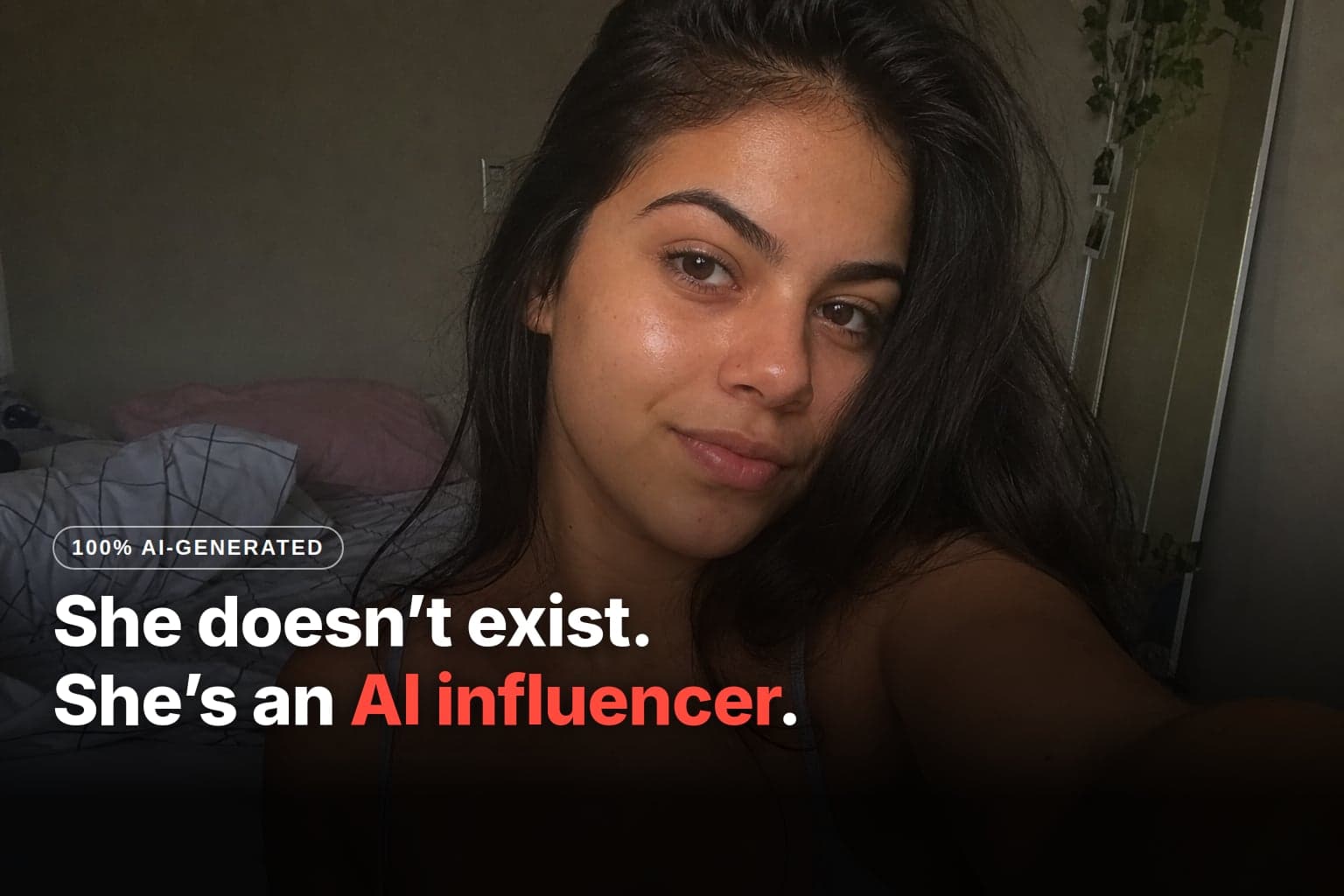
I generated the selfie below, plus 18 more photos throughout this guide, in Avatrix with AI: no camera, no human model. The gym shot a little further down has acne marks on the chin and people working out in the background. The product shot has the bottle's shadow on the concrete and exactly the right frosted glass. None of them screams AI, and the secret wasn't asking for "8k cinematic hyper-realistic". It was the opposite.
The number one mistake people make when generating AI photos is stacking pretty words: "cinematic", "8k", "hyper-realistic", "flawless". That is exactly what produces the AI look: waxy skin, render glow, a face that's too perfect. Real realism comes from reproducing what exists in an actual photo: the physics of a real camera, skin texture up close, and permission to be imperfect.
For this guide I ran 19 photos on Reference, the image model built into Avatrix, a Brazilian platform for creating AI influencers. They cover very different kinds of photos: influencer selfies, product shots for an online store, a LinkedIn headshot, a beauty portfolio, and the same person in different scenes with the face locked in. Each one comes with a screenshot of the result and the raw prompt in a block for you to copy.
Everything here was actually generated: I ran it on the account myself, I didn't borrow examples from somewhere else. Wherever there's a photo, the prompt that generated it sits right below. No promises, just the process with proof.
Where does this run in Avatrix?
You generate the photos in the Workflow: click New creation and open the Image card. The Reference model comes preselected there ("Great with references"). It's the Avatrix image model that gets text right most often and keeps the face consistent. Before generating, you choose two things: the quality (1K, 2K or 4K) and the aspect ratio.
On aspect ratio, here's the most important warning in this post, which I found by measuring the files one by one. The card offers ten aspect ratios, but the Reference model only truly honors three: 9:16 (portrait), 1:1 (square) and 16:9 (landscape). The others (4:5, 3:2, 3:4…) all fall back to 16:9 at generation time.
So stick to those three: 9:16 for full-body shots of people, 1:1 for close-ups and headshots, 16:9 for products, food, real estate and any horizontal photo.
Now the formula. It shows up in full in the first prompt and repeats in all the others; you'll recognize the pattern by the third one.
The base formula: the four ingredients of realism
Every realistic photo that came out of this test has the same four ingredients in the prompt. This isn't theory: it's the skeleton that repeats in every prompt in the guide.
- A real camera. Instead of "professional photo", name the gear:
iPhonefor a selfie,Canon EOS R5, 85mm f/1.8for a portrait,Kodak Portra 400for an analog film look. That steers the model toward its bank of real photos. - Light with a source, direction and temperature. Light that comes equally from everywhere reads to the brain as an illustration.
window light from the left, 5500K, shadow falling to the rightcreates a shadow on one side only, and that looks like a photo. - Skin with texture. Left alone, the model drifts toward smooth skin and an overly perfect face. You force realism by asking for the flaws:
visible pores, slight oil sheen on the forehead, micro-imperfections, natural asymmetry. - Explicit negatives. The bans go at the end of the prompt:
no plastic skin, no airbrush, no smoothing, no AI render look. The Reference model respects these negations inside the prompt text itself.
Keep this in mind. The rest of the post is these four ingredients applied to each type of photo.
A. Influencer and niche photos (the easiest place to start)
This is the heart of the feed: mirror selfies, beach shots, gym, skincare. They're amateur phone photos, so the realism here lives in the mess, not in the polish.
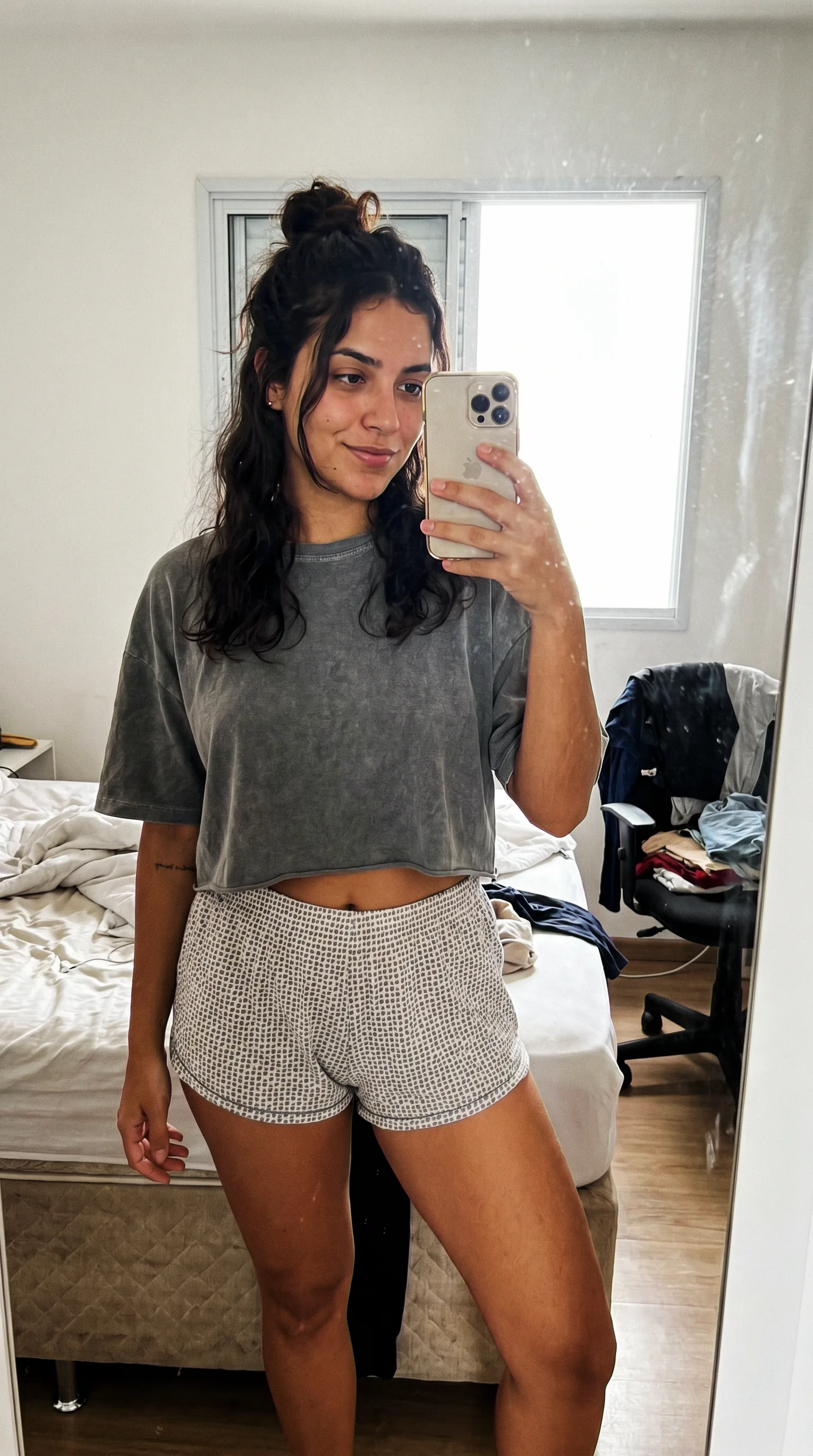
Bedroom mirror selfie
This is the type that goes viral most often and the hardest to make look real. What fools the eye isn't the pose. It's the messy scene plus the exposure behavior of a real phone: the unmade bed, the pile of clothes on the chair, the fingerprint smudges on the mirror, and the window blowing out to white behind her, because every backlit phone photo blows out the window. AI drifts toward a clean scene and balanced, ad-style exposure, so you ask for the opposite.
Casual full-body mirror selfie taken on an iPhone of EXACTLY ONE young
23-year-old Brazilian woman alone, naturally very pretty in a girl-next-door
way, youthful fresh soft face, full lips — but a REAL person not a model
composite: subtle natural asymmetry, one eye a touch smaller, slightly uneven
eyebrows, warm olive skin with a few faint irregular blemishes of different
sizes, dark wavy hair in a messy loose bun with flyaways. Normal young body
with relaxed posture, fit but NOT gym-sculpted: soft natural waist, normal
hips, legs full natural length, weight on one hip, anatomically correct
proportions, correctly sized head. She wears an oversized cropped t-shirt with
a faded print and high-waisted cotton shorts slightly bunched at the
waistband, holding the phone in front of her face in a large mirror with
fingerprint smudges, in a cozy messy bedroom: unmade bed, pile of clothes on a
chair, charger cable on the floor. Real phone exposure behavior: the window
behind is blown out to white with a mild HDR halo, her face slightly
underexposed, lifted flat shadows, slightly washed contrast, over-sharpened
crunchy detail, subtle sensor grain, slight framing tilt. Looks exactly like a
real unedited mirror selfie from a phone camera roll. no professional
photography, no studio lighting, no perfect facial symmetry, no model bone
structure, no fitness-model body, no stamped freckles, no second person, no
other people, no oversized head, no shortened legs, no waxy skin, no airbrush,
no 8k, no cinematic, no hyperrealistic, no flawless skin, no posing, no
middle-aged woman, no mature face, no aged skin
Reference · 2K · 9:16.
Sweaty gym selfie
The lesson here is that ugly light is realism too. Instead of asking for pretty light, you ask for the harsh fluorescent light of a gym: short downward shadows, a cold reflection off the mirror. The sweat comes in through dermatologist vocabulary: oil sheen, droplets at the hairline, visible pores. And the phone's reflection in the mirror anchors it as a real phone photo.
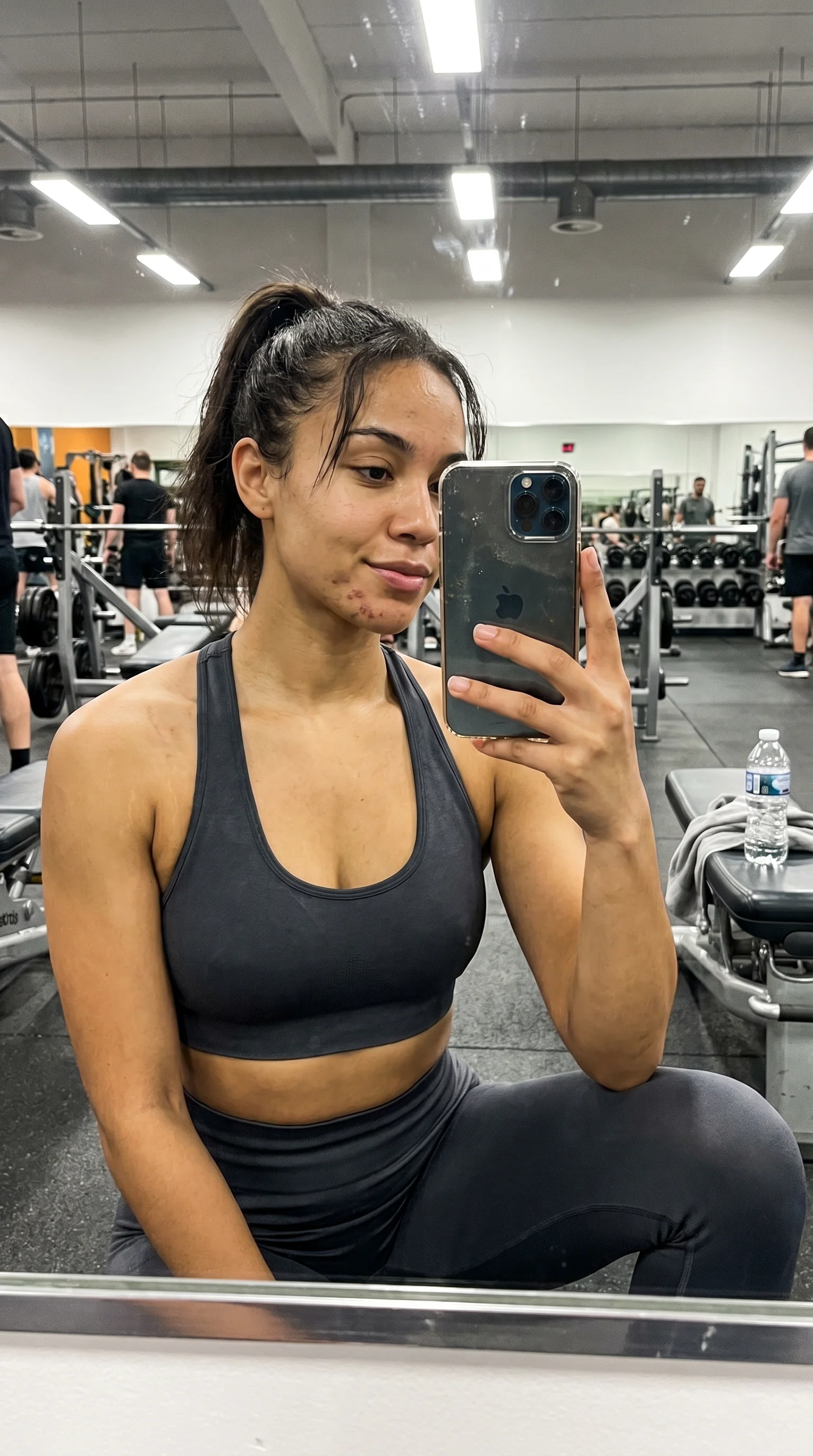
Casual gym mirror selfie taken on an iPhone of a fit 24-year-old mixed-race
Brazilian woman with light-brown skin, long dark hair in a high tight ponytail
with a few flyaways stuck to her forehead, small acne marks on the jaw, faint
stretch lines on the shoulder. She wears a charcoal seamless sports bra and
matching leggings, holding the phone at chest height, confident relaxed stance.
Modern gym behind her with squat racks, plates and mirrors, harsh overhead
fluorescent lighting at around 4500K casting short downward shadows under the
brow and collarbone, a cooler reflection from the mirrors. Realistic skin
slightly sweaty with visible pores, natural oil sheen on the forehead and
collarbone, droplets at the hairline, faint flush on the cheeks, slight
asymmetry, no smoothing. The phone screen reflects in the mirror, smudges and
fingerprints on the glass, a water bottle and towel on the bench behind. Shot
like a real front-camera gym snapshot: subtle sensor grain, accurate white
balance, mild digital noise from the indoor light. Looks exactly like a real
fitness influencer post, amateur snapshot, photographic, natural gym lighting,
no studio lighting, no AI render look, no plastic skin, no flawless skin.
Reference · 2K · 9:16.
Beach at golden hour
This one shows the formula works for a mature man without losing realism. The light isn't described as studio light; it's described the way a phone behaves against a low sun: blown-out highlights on the wet skin, lens-flare smear, his face slightly underexposed with HDR lifting the shadows flat. And the subject is moving (walks out of the sea, mid-stride) instead of posing, because a static pose is one of the strongest AI tells. A detail that cost me an extra generation: "real person" language ages the subject. Without youthful, looks young for his age and the age negatives at the end, the model gave me a man of about 50 instead of 38.

Amateur smartphone photo of EXACTLY ONE youthful athletic 38-year-old Black
Brazilian man alone in the frame, looks young for his age, deep brown skin,
short cropped black hair with just a few subtle grey strands at the temples,
short well-groomed dark beard, a small scar above the left eyebrow — a REAL
person not a model composite: slight facial asymmetry, visible pores, natural
uneven skin tone on the forearms from sun exposure.

He walks out of the sea on a Brazilian beach at golden hour, simple navy swim
shorts, water dripping down his chest, relaxed half-smile looking slightly
off-camera, mid-stride caught in motion.

Real phone behavior against the low sun: warm backlight with blown-out
highlights on the wet skin and water, lens-flare smear, his face slightly
underexposed with HDR lifting the shadows flat, wet sand reflecting the orange
sky, a couple of blurred beachgoers far in the background, amateur smartphone
photo signature: Smart-HDR processed look with lifted flat shadows and dull
compressed highlights, slightly washed-out contrast, over-sharpened crunchy fine
detail, background only slightly soft with busy bokeh from a small phone sensor
NOT creamy blur, subtle luminance grain, imperfect white balance, casual
slightly tilted framing.

Looks exactly like a real vacation photo taken by a friend on a phone, unedited,
from the camera roll.

no professional photography, no DSLR, no portrait-lens compression, no rim
light, no film emulation, no cinematic color grading, no perfect facial
symmetry, no model bone structure, no stamped freckles, no second person, no
other people in the frame, no waxy skin, no airbrush, no 8k, no cinematic, no
hyperrealistic, no flawless skin, no old man, no elderly man, no full grey hair,
no white hair, no balding, no receding hairline, no deep wrinkles, no aged face,
no mature face, no aged skin, no camera app interface, no UI elements, no
timestamp, no text overlay
Reference · 2K · 9:16.
Skincare close-up with real skin
Beauty photos are where the AI look shows the most, and the trick is the close-up. Forcing close-up spends the image's detail on the face and avoids the melted face you get in wider shots. Then comes the vocabulary of real skin: visible pores, peach-fuzz, age spots, iris with specular highlights, dewy but not glossy. The model is 45, with her age visible on purpose: skin that's too smooth falls into the uncanny valley.
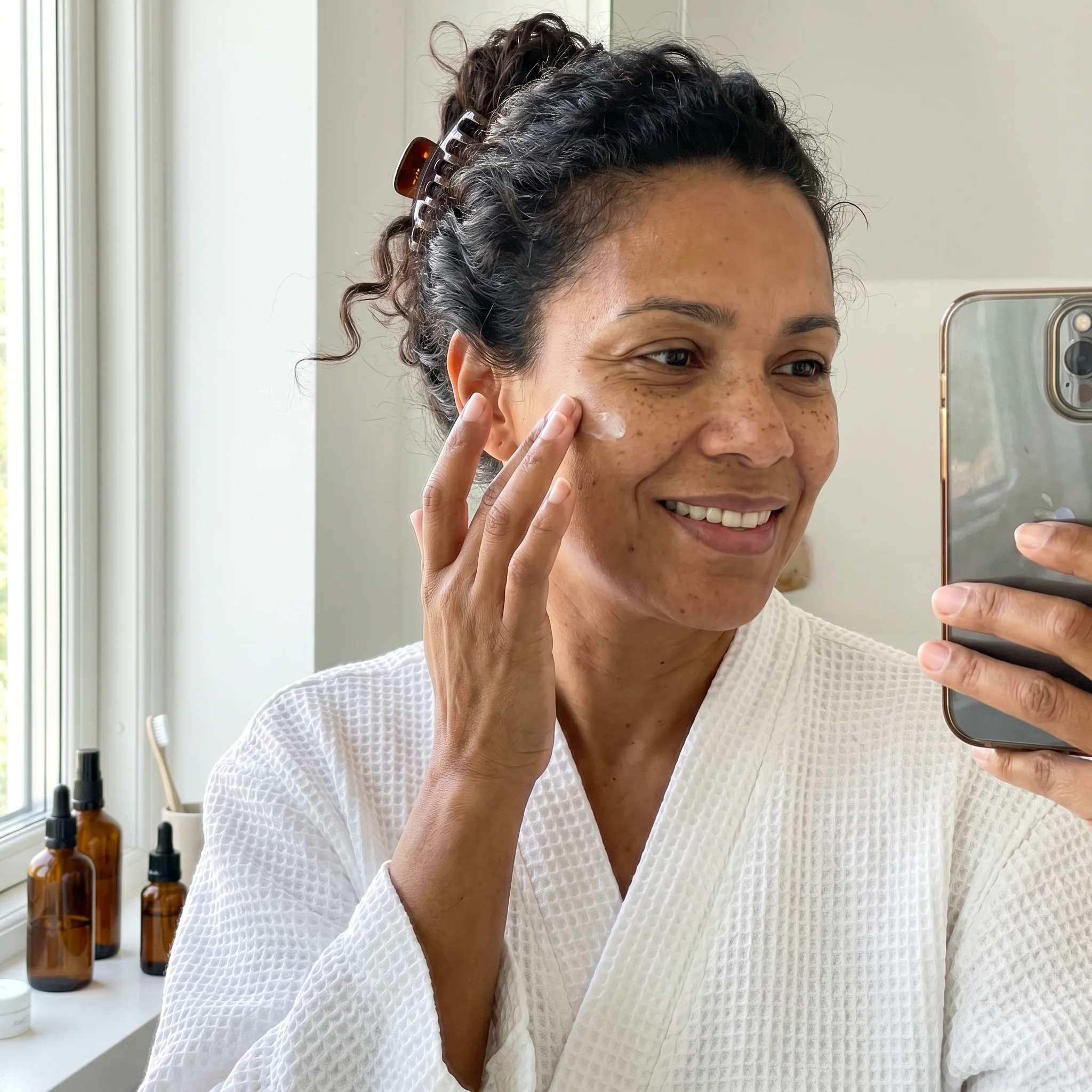
Casual close-up mirror selfie taken on an iPhone of a 45-year-old Brazilian
woman with medium-deep warm-toned skin, dark hair pinned up with a few loose
strands, natural expression lines around the eyes and mouth, visible age spots
and faint sun freckles on the cheeks, applying a dab of moisturizer with two
fingers to her cheekbone. She wears a white cotton bathrobe, fresh bare face
with no makeup. Bright bathroom with soft natural daylight from a window on
camera left at around 5500K, even gentle fill, subtle catchlight visible in
both eyes. Realistic skin with clearly visible pores, fine lines, peach-fuzz
vellus hair on the cheek, natural uneven pigmentation, slight oil sheen on the
nose, subtle asymmetry, dewy but not glossy, no smoothing whatsoever. Detailed
iris with specular highlights, individual eyebrow hairs. The phone and her hand
partly in frame, light water spots on the mirror, a couple of skincare bottles
on the counter. Shot like a real front-camera beauty snapshot at close range,
subtle sensor grain, accurate white balance. Looks exactly like a real beauty
influencer morning skincare routine post, candid, amateur snapshot,
photographic, no studio lighting, no AI render look, no plastic skin, no
airbrush, no poreless skin, no glamour retouch, no smoothing.
Reference · 2K · 1:1.
Luxury lifestyle without the render look
Aspirational photos (a car, a big house) are where everyone slides into plastic. I tested the obvious route first, emulating a professional camera (Canon EOS R5, 85mm, Kodak Portra 400), and the result comes out too pretty: perfect rim light on the hair, a creamy background, magazine-cover golden light. It turns into a photographer's photo. And a photographer's photo in a feed raises the same suspicion as waxy skin. What holds the realism is the opposite: a phone signature (flat HDR shadows, washed-out contrast, a nearly sharp background), harsh midday sun with unforgiving shadows, and a real candid moment, with her squinting against the light and laughing at someone off-frame. Ugly light and crooked framing are what the brain expects from a real photo. And the aspect ratio here is 16:9 on purpose, breaking the full-body rule: the scene is wider than she is, and the car and the house matter as much as the person.
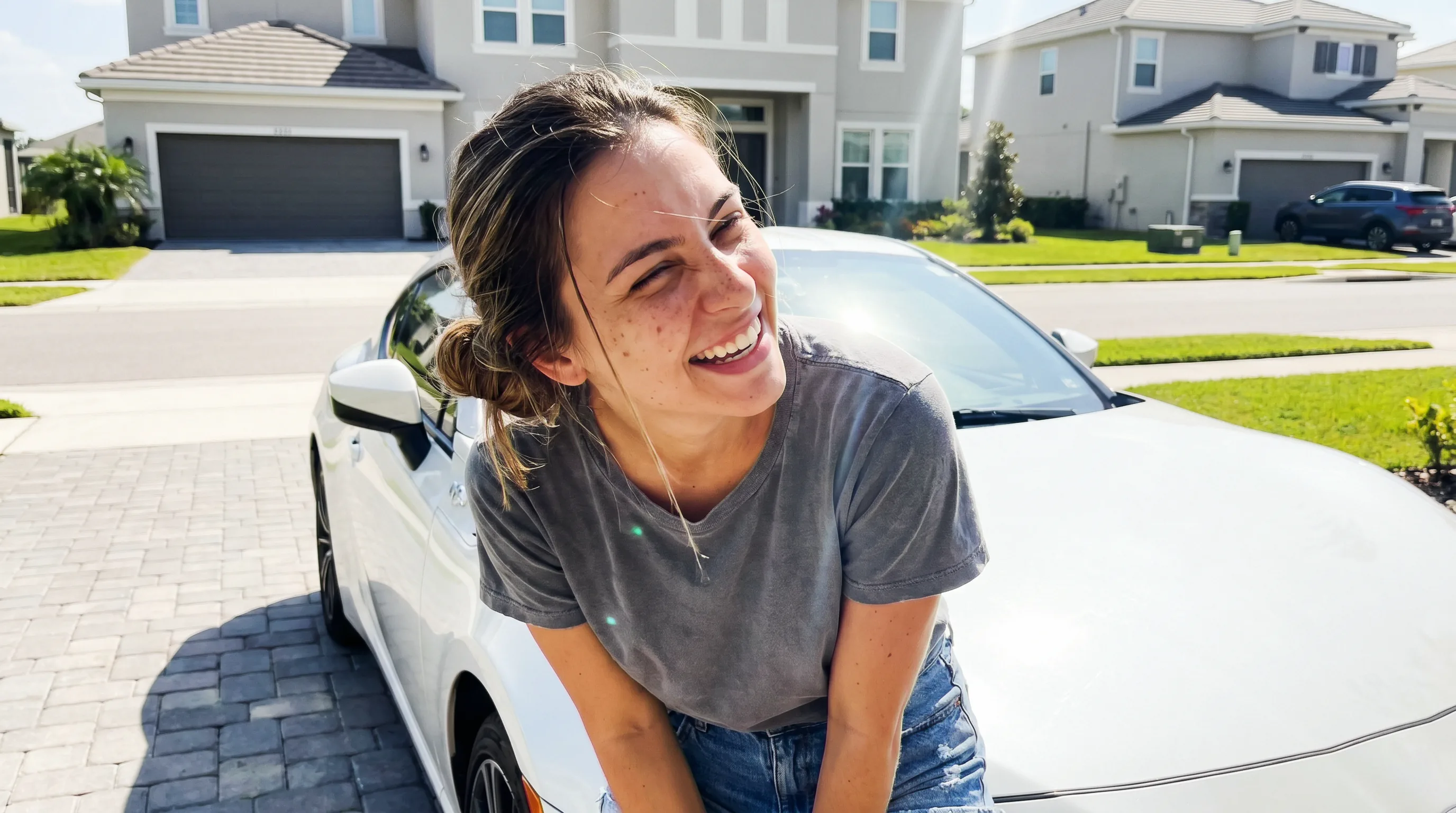
Amateur smartphone photo taken on an iPhone of EXACTLY ONE young 23-year-old
Brazilian woman alone in the frame, naturally very pretty in a girl-next-door
way, the prettiest girl from your neighborhood, youthful fresh smooth face,
full lips, warm tanned skin — but a REAL person not a model composite: subtle
natural facial asymmetry, one eye a touch smaller than the other, slightly
uneven eyebrows, normal teeth, real-people proportions, NOT golden-ratio
symmetric. A few faint irregular freckles of different sizes and opacity
scattered naturally across the cheeks and nose, following the skin planes.
Dark-blonde hair tied in a quick messy low bun, loose flyaway strands stuck to
her face. She leans casually against a white sports car in the driveway of a
large modern house, harsh bright midday sun overhead, unflattering hard
shadows under her chin and nose, blown-out white highlights on the car paint,
deep hard shadows on the pavement, she squints hard against the bright light
laughing at someone off-frame, weight on one leg, relaxed not posing.
Phone-camera optical signature: Smart-HDR processed look with lifted flat
shadows and dull compressed highlights, slightly washed-out contrast,
over-sharpened crunchy fine detail, background only slightly soft with busy
nervous bokeh from a small phone sensor NOT creamy blur, mild lens-flare smear
from the sun, imperfect white balance, luminance noise in the shadows. Casual
awkward framing: slight tilt, a bit too much headroom, subject slightly
off-center. Looks exactly like a real unedited photo from a phone camera roll
posted to an Instagram story. no professional photography, no DSLR, no
portrait-lens compression, no rim light, no cinematic color grading, no
perfect facial symmetry, no model bone structure, no stamped identical
freckles, no second person, no other people in the frame, no waxy skin, no
airbrush, no 8k, no cinematic, no hyperrealistic, no flawless skin, no posing,
no middle-aged woman, no mature face, no aged skin, no timestamp, no golden
hour glow, no warm filter
Reference · 2K · 16:9.
B. Photos for local and commercial businesses
The formula isn't just for people. If you run a store, a restaurant, a real estate agency or a barbershop, you need photos that sell, and here the Reference model has one more trick: it gets label and sign text right.
Product photo for e-commerce
A real product photo has an optical signature: named light (softbox at 45 degrees + fill + rim), a real surface with a contact shadow (nothing floating), and the right material (frosted glass with accurate caustics where the light passes through). The f/8 macro keeps everything sharp, and the empty space on the right is intentional, so you can add the price or a headline on top later.
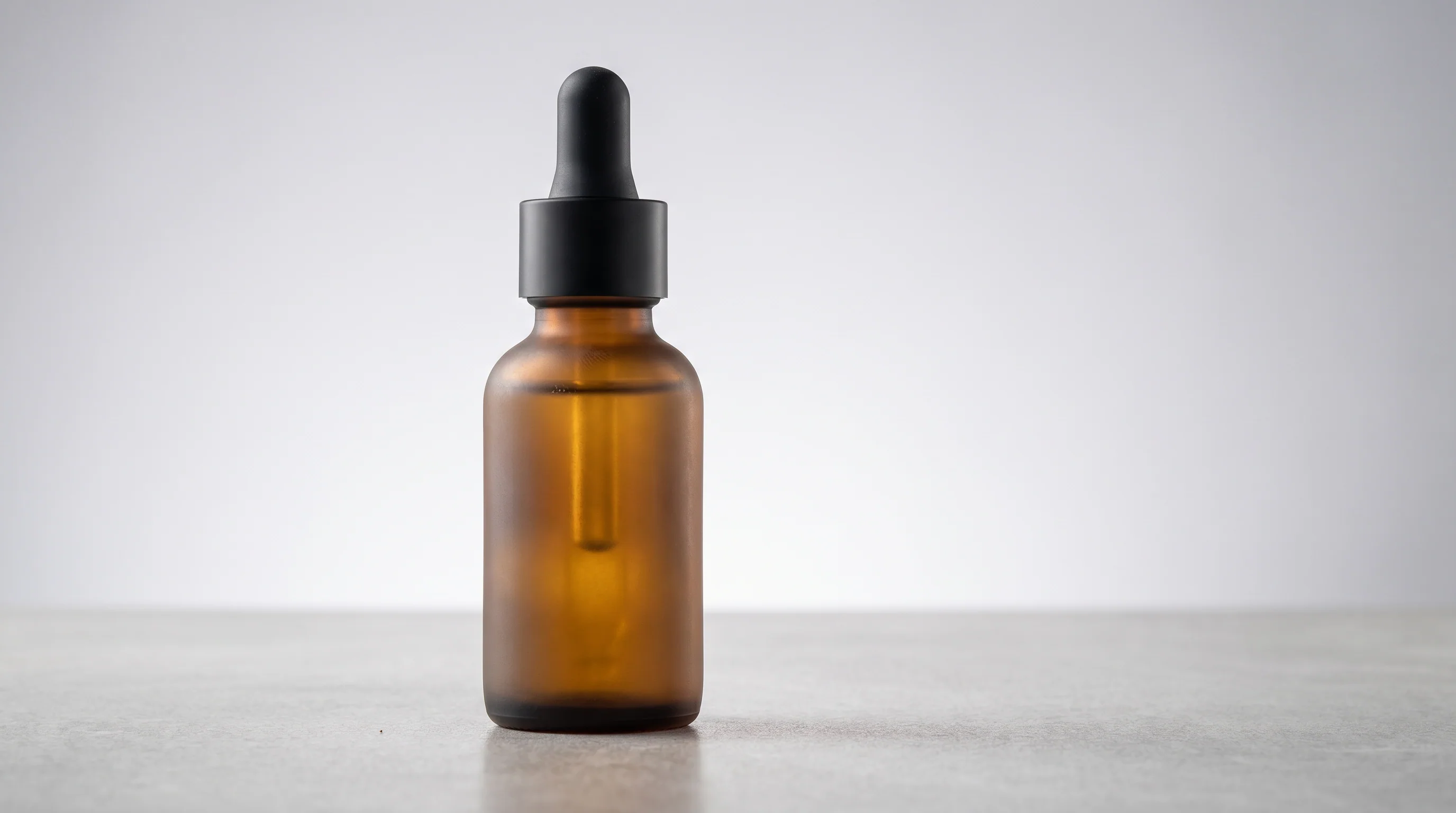
Needs a reference. Upload 1 to 3 photos of YOUR product (front, side, label detail) and add
same product as the reference image, keep the exact label, logo and bottle shape identical. Without a reference, the model invents the label and changes the bottle shape.
Product photograph of a frosted amber glass skincare serum bottle with a matte
black dropper cap, centered on a polished light-grey concrete surface against a
soft light-grey gradient sweep background. Single softbox positioned at 45
degrees from camera left as the key light, subtle fill card from camera right
to open the shadows, faint rim light along the right edge of the bottle for a
premium pop. Matte glass finish with controlled specular highlights, accurate
caustics where light passes through the amber liquid, a slight elongated contact
shadow anchoring the bottle to the surface, one tiny realistic fingerprint
smudge near the cap, a faint speck of dust on the concrete. Shot on a Canon EOS
R5, 100mm macro lens, f/8 for edge-to-edge sharpness, 5500K neutral daylight
white balance. Sharp real surface micro-texture, subtle sensor grain,
true-to-life color, generous negative space on the right for marketing text.
Real product photograph straight out of a studio, not a 3D render, no CGI, no
oversharpening, no oversaturation, no plastic-looking glass, no floating
subject, no fake reflections.
Reference · 2K · 16:9.
Mouthwatering food photo
Food rests on three pillars: the appetizing micro-detail, named one by one (glistening oil sheen, condensation on the glass, coarse salt crystals, grease smear on the plate), soft side light from a window (banning direct flash and fluorescent light, which kill appetite), and the plate anchored on a real surface. A technical detail: a burger doesn't give off visible steam, so I asked for warmth haze instead of steam. Wrong physics creates the AI look instantly.
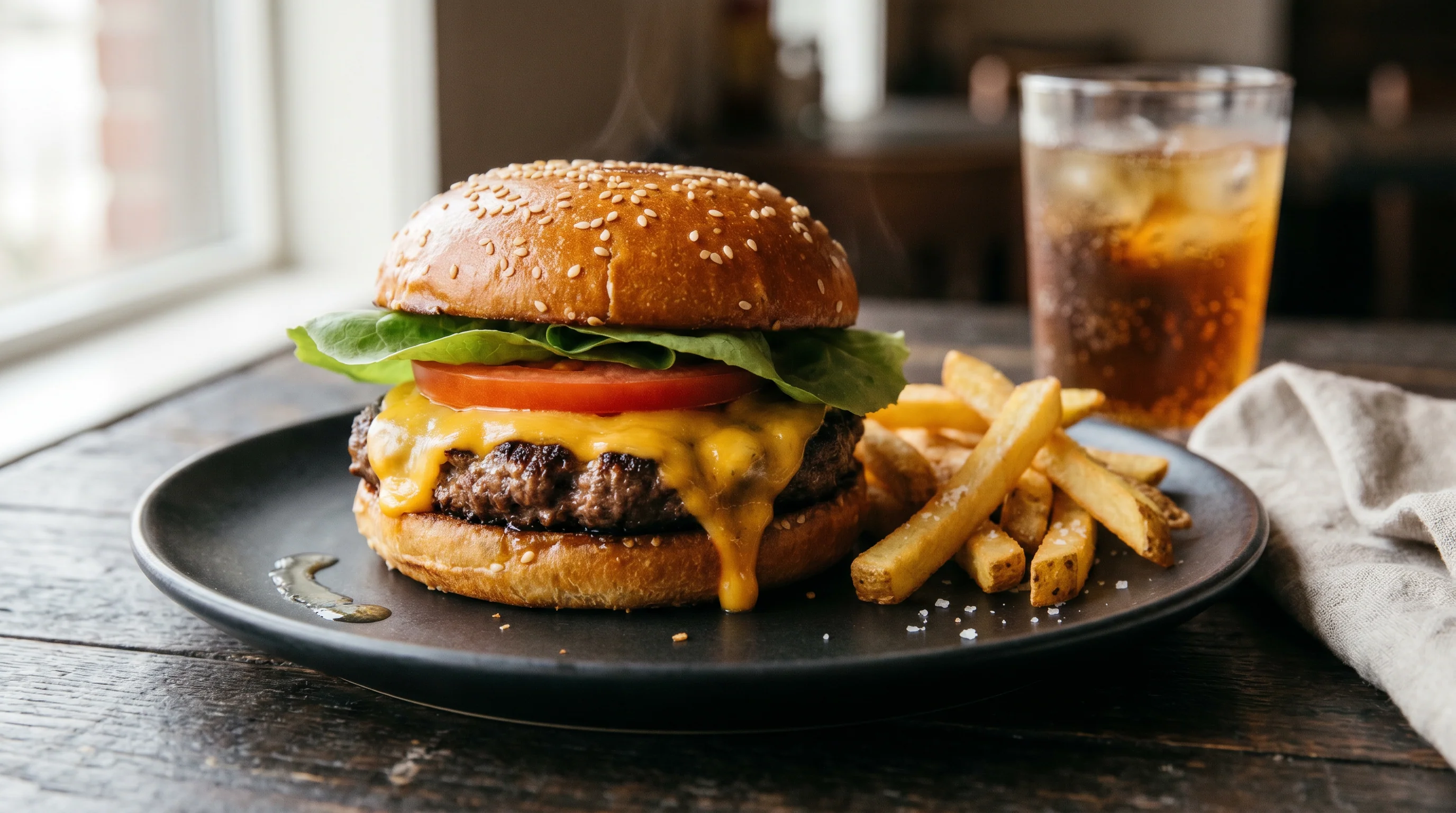
Appetizing food photograph of a rustic smash burger with melted cheddar
dripping over the edge, a toasted brioche bun with visible sesame seeds, fresh
lettuce and a thick tomato slice, plated on a dark matte ceramic plate with a
few golden hand-cut fries beside it. Shot from a 45-degree angle. Soft natural
window light coming from the left casting gentle directional shadows to the
right, warm 5000K daylight. Visible micro-detail: glistening oil sheen on the
patty, a faint warmth haze rising just above the melted cheese, condensation
droplets on a cold glass of soda in the soft background, crumb texture on the
bun, coarse salt crystals on the fries, a small grease smear on the plate rim.
Background is a dark weathered wood table with a crumpled linen napkin and an
out-of-focus restaurant interior. Shot on a Canon EOS R5, 85mm lens, f/2.8 for
shallow depth of field, natural film grain, slight vignetting, true-to-life
appetizing color. Real food photograph, no direct flash, no overhead
fluorescent light, no CGI, no plastic-looking food, no glossy render sheen, no
oversaturation.
Reference · 2K · 16:9.
Real estate listing photo
What separates a professional listing from an amateur one is technical: straight verticals (tilt-shift, no fisheye), a light source with a direction (south-facing window in the afternoon creating pools of light on the floor), and balanced exposure so the window doesn't blow out. A wide-angle interior has fine texture (wood, fabric), so 2K is mandatory: 1K blurs the weave.
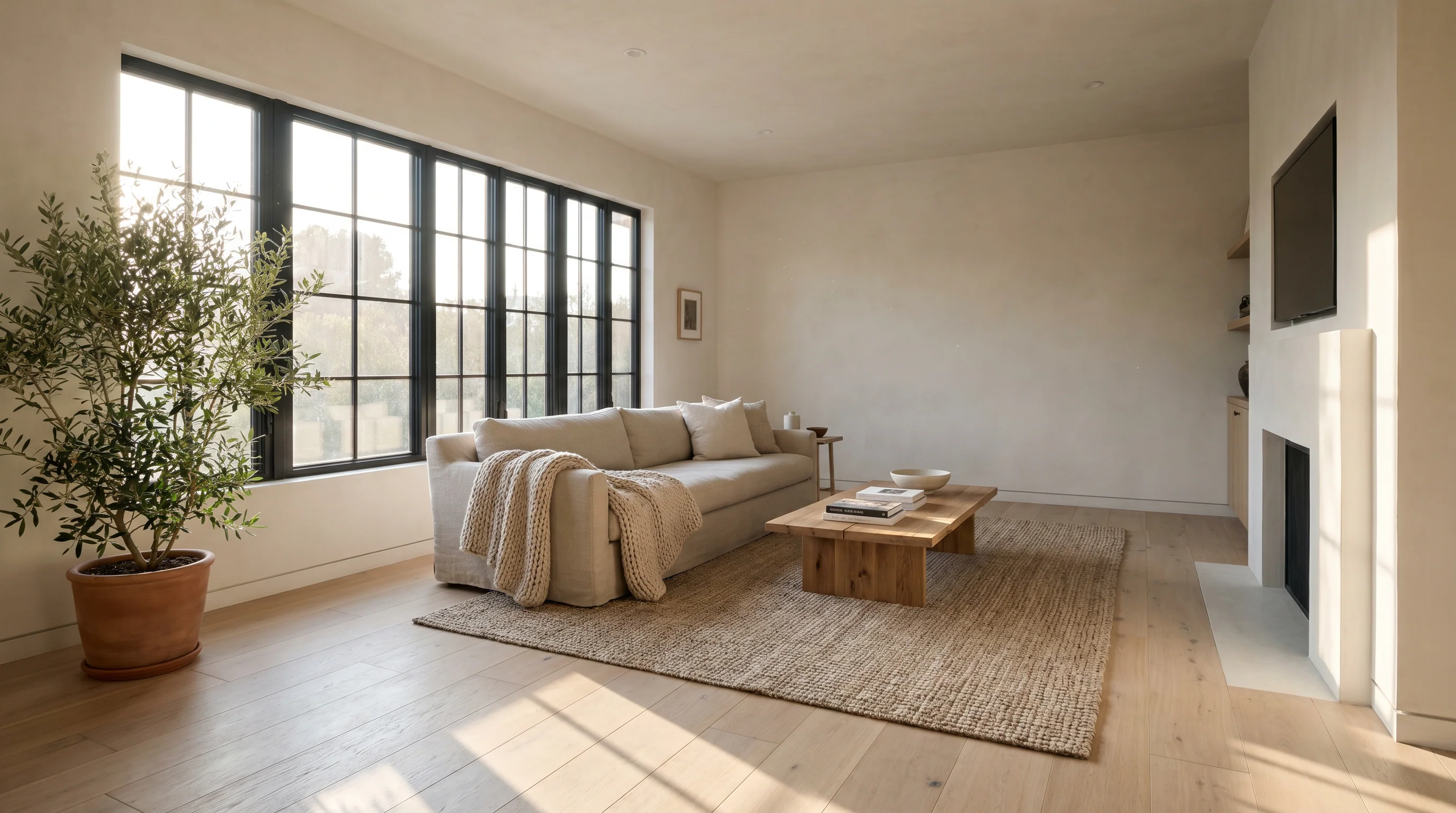
Wide-angle real estate interior photograph of a bright contemporary living
room. Large south-facing windows let in soft natural afternoon sunlight that
casts warm rectangular pools of light across wide-plank white oak flooring with
a matte finish. A neutral linen sofa with a textured throw blanket, a low
wooden coffee table, a leafy potted plant and a soft area rug. Clean uncluttered
composition, lived-in but tidy. Shot on a Sony A7R IV, 16-35mm lens at 18mm,
f/8 for deep focus, straight vertical lines with tilt-shift perspective
correction, no fisheye distortion, level tripod, HDR-balanced exposure so the
windows are not blown out and shadows stay open. Accurate white balance,
professional listing photography color grade, realistic material textures on
wood, fabric and plaster, subtle real-world wear and natural dust in the light
beams. Photorealistic real estate photo, MLS-friendly, no clutter, no warped
verticals, no CGI, no over-processing, no impossible double shadows, no fake
window reflections, no over-rendered glow.
Reference · 2K · 16:9.
Business owner in their own space
A business-owner photo that looks taken on the spot needs two tweaks: the subject in motion (mid-smile, holding clippers) instead of a stiff pose, and believable mixed light (shop tungsten + window) with catchlights in the eyes. The background stays a bit messy and out of focus on purpose. Notice the small handwritten price sign in the background: it came out legible. The Reference model gets text right, and that's gold for business photos.

Needs a reference. Upload up to 4 photos of the owner's face from different angles and add
same person as the reference image, keep 100% identical facial features, restating 2 or 3 traits (full beard, scar on the eyebrow, arm tattoo). Re-attach the reference every 5 to 8 generations.
Candid environmental portrait of a 38-year-old Black Brazilian barber with a
short fade haircut, a well-groomed full beard, a small healed scar above the
left eyebrow and a faded forearm tattoo, wearing a charcoal canvas barber apron
over a white t-shirt, standing relaxed beside his barber chair holding clippers,
half-turned toward the camera mid-smile. Realistic skin with visible pores,
natural oil sheen on the forehead and nose, faint laugh lines, slight asymmetry,
a few stray beard hairs. Warm tungsten shop light from overhead at around 3500K
mixed with soft daylight from a street-facing window on camera left, gentle
catchlights in both eyes, realistic shadows falling to the right. Background
shows a real barbershop interior softly out of focus: mirror, scattered bottles,
a slightly cluttered shelf, a hand-written price sign. Shot on a Sony A7 III,
50mm lens, f/2 for natural perspective and shallow depth of field, Kodak Portra
400 film emulation, subtle film grain, accurate white balance. Authentic candid
documentary photo, natural color grading, no studio lighting, no plastic skin,
no poreless skin, no airbrushing, no AI render look, no oversaturation.
Reference · 2K · 9:16.
Model wearing the garment for a catalog
A catalog sells the garment, so what matters is fabric texture that's sharp and in focus (knit weave, folds in the wool, a bit of lint). And a diverse model (a 55-year-old woman, gray hair, curvy body) breaks the dead stare of the young, thin average that AI drifts toward on its own. Named softbox light with a rim light and a contact shadow on the floor (nothing floating) gives it the feel of a real lookbook.
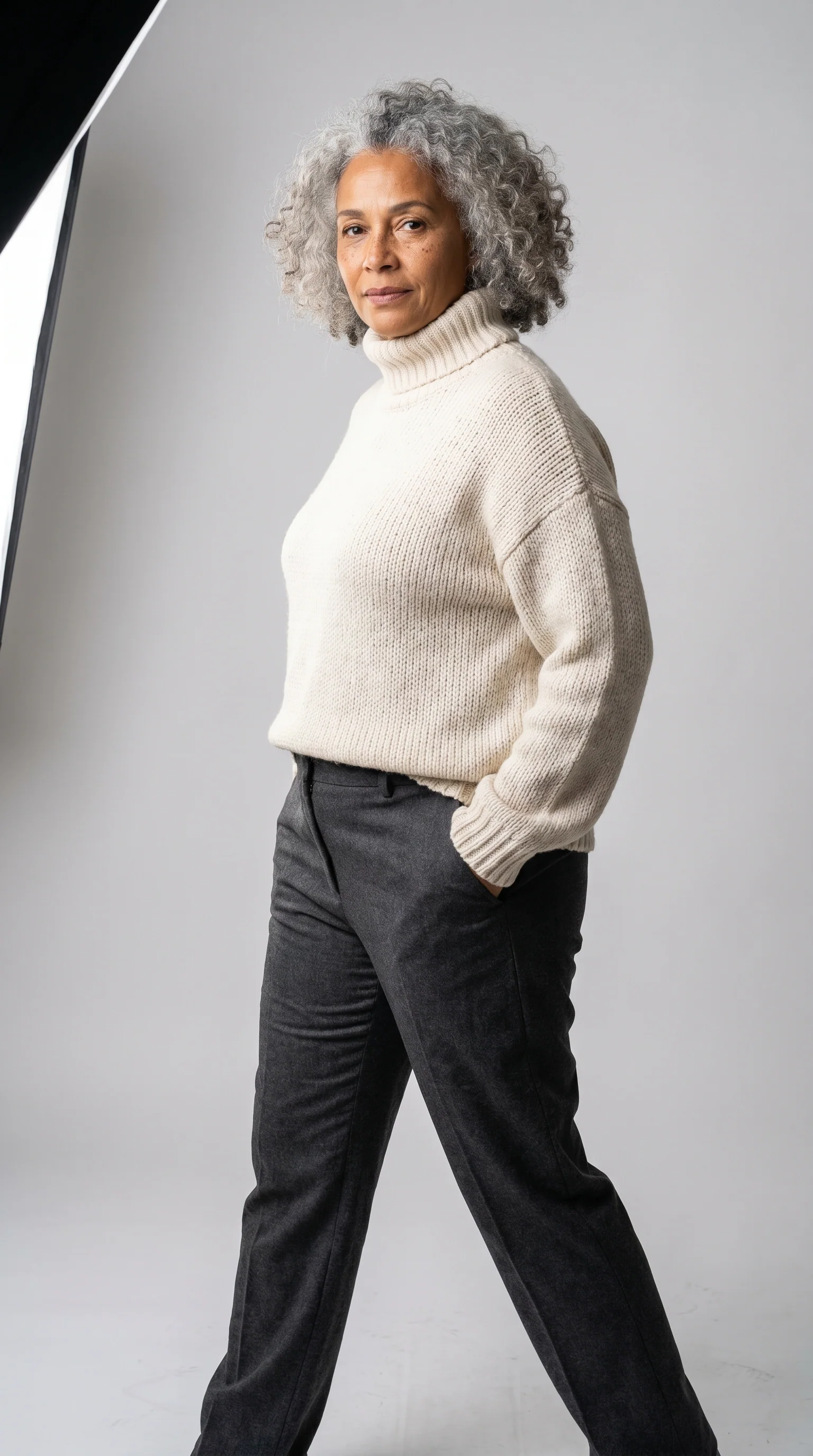
Needs a reference. To sell YOUR garment, upload a front photo of the real piece and add
keep the exact garment, color and knit pattern from the reference image. To repeat the same model across the catalog, upload up to 4 face references.
Studio lookbook fashion photograph of a 55-year-old Brazilian woman with
medium-deep skin and a warm golden undertone, natural silver-grey curly hair,
light freckles and soft expression lines, a curvy body type, standing
three-quarter to camera with one hand resting in her pocket, in a relaxed
mid-stride pose. She is wearing a cream knit oversized turtleneck and tailored
charcoal wool trousers. Realistic skin with visible pores, fine lines, natural
slight asymmetry, no smoothing. Seamless light-grey studio backdrop. Softbox
key light with gentle falloff from camera left, soft fill from the right, faint
rim light tracing the hair and shoulders, subtle catchlights in both eyes,
realistic soft contact shadow on the floor. Sharp focus on the fabric: visible
knit weave of the turtleneck, soft natural folds and a few real wrinkles in the
wool trousers, a tiny bit of lint on the knit. Shot on a Sony A7 IV, 85mm f/1.4
lens, shallow depth of field, neutral color grading, accurate true-to-life
color, subtle film grain. Premium catalog aesthetic, real photograph, no
plastic skin, no airbrushing, no poreless skin, no AI render look.
Reference · 2K · 9:16.
C. High-end studio and portfolio photos
This is where the level goes up. The difference from casual shots is that light becomes the star: every source has a named position, modifier and shadow direction. It's peak realism without needing a reference.
Corporate LinkedIn headshot
A headshot calls for the canonical portrait lens (85mm f/1.8) and north-facing window light in a loop pattern (the nose shadow that doesn't touch the cheek), with twin catchlights in the eyes at 10 and 2 o'clock. The trick here is a mature man's skin: asking for wrinkles, a scar and uneven pigmentation forces the AI to drop the smoothing that gives headshots a waxy face.

Professional head-and-shoulders corporate headshot of a 48-year-old white
Brazilian man with salt-and-pepper hair, neatly trimmed graying beard, light
crow's-feet around the eyes, sun-weathered forehead, a faint old scar on the
left eyebrow. Natural skin texture with visible pores, fine lines, subtle
uneven pigmentation, slight natural redness on the cheeks, slight facial
asymmetry, no smoothing, no airbrushing. Calm confident expression, slight
closed-mouth smile, looking just past the lens. Wearing a navy wool blazer over
a crisp white shirt, open collar, fabric weave and soft folds visible. Neutral
mid-gray seamless studio background with gentle falloff. Lighting: soft key
light from a large north-facing window camera-left at eye level in a loop
pattern (small nose shadow not touching the cheek), gentle bounce fill
camera-right, faint rim light tracing the shoulder and hair from behind, twin
softbox catchlights at 10 and 2 o'clock in both eyes. Shot on a Sony A7 IV, 85mm
f/1.8 lens, sharp focus on the eyes, shallow depth of field, background softly
blurred. Accurate white balance, neutral true-to-life color grading, subtle
sensor grain, unretouched look. Documentary corporate portrait realism. Avoid:
plastic skin, waxy skin, beauty filter, AI glow, poreless, flawless skin,
perfect symmetry, over-smoothing, 3D render.
Reference · 2K · 1:1.
Magazine-style fashion editorial
Here the lighting setup is what makes the photo look real instead of generic "studio lighting" (which turns into that flat render lighting). Each source has a name and a position: octabox at 45 degrees + gridded fill + rim light from behind. And the shape of the catchlight in the eye, rectangular from the softbox, is the signature of real light.
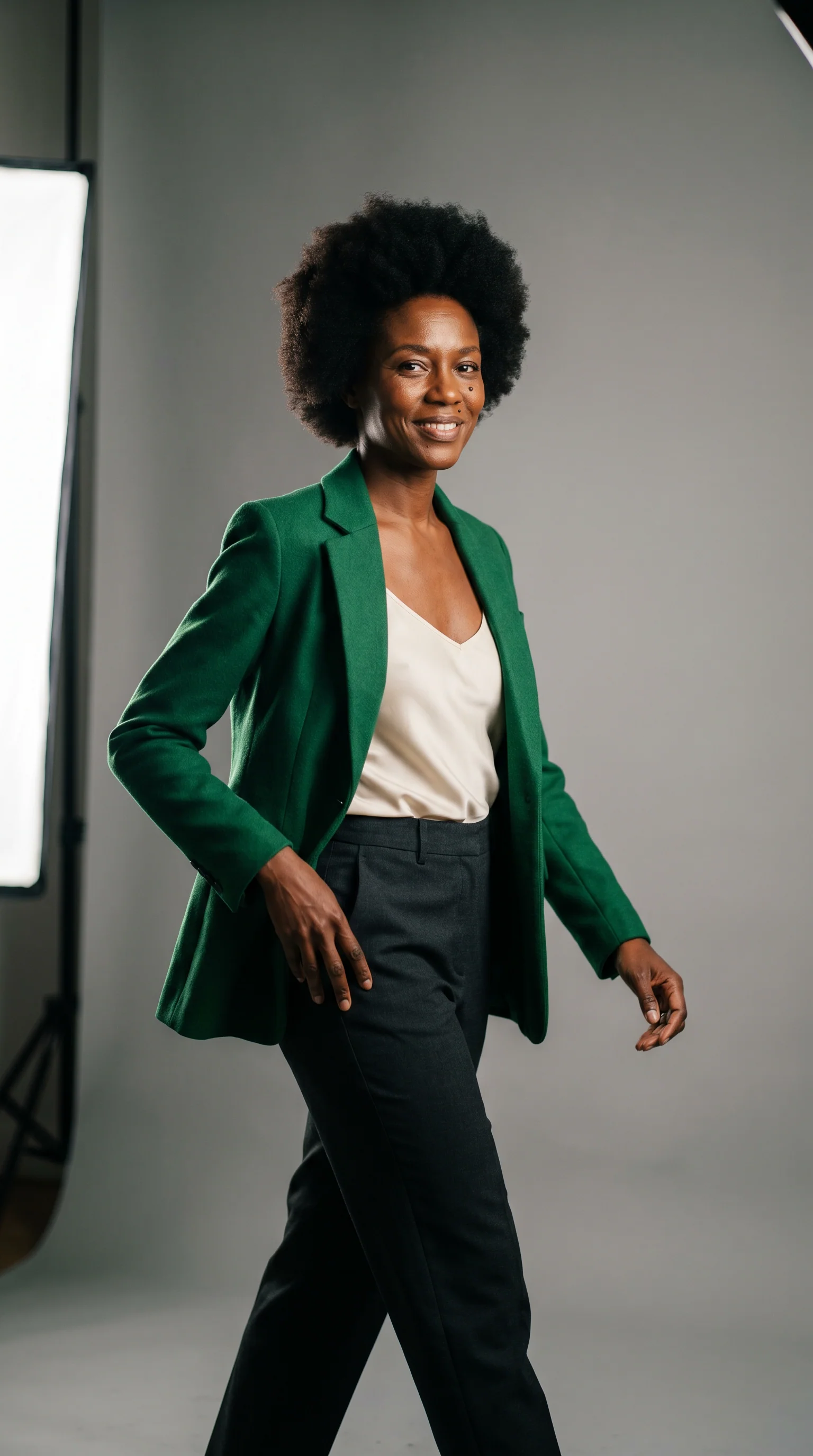
Full-length editorial fashion photograph of a 32-year-old Black Brazilian woman
with deep warm-brown skin, short cropped natural afro, sharp cheekbones, a small
beauty mark below the right eye, slightly uneven eyebrows. Natural skin texture
with visible pores, fine microtexture, subtle natural sheen on the high points,
faint laugh lines, slight facial asymmetry, no airbrushing. She is mid-stride
turning her shoulder toward the lens, one hand grazing the hip, wearing a
structured tailored emerald-green wool blazer over a cream silk camisole and
high-waisted charcoal trousers; fabric weave, soft natural wrinkles and slight
fabric tension at the elbow visible. Smoke-gray seamless cyclorama backdrop.
Lighting: large octabox key light at 45 degrees camera-left feathered slightly
above eye level, gridded fill at 25 percent camera-right, hair/rim light from
behind tracing the shoulder and afro edge, soft directional shadows falling to
the right, one large rectangular softbox catchlight visible in both eyes. Shot
on a Canon EOS R5, 85mm f/1.4 lens, shallow depth of field, focal plane on the
eyes, creamy circular bokeh on the backdrop, subject razor-sharp. Kodak Portra
400 film emulation, soft highlight roll-off, accurate neutral white balance,
natural film grain visible in the shadow areas, subtle vignetting. Editorial
fashion photography, candid captured-moment realism, unretouched skin look.
Avoid: plastic skin, waxy skin, over-smoothing, airbrushed, poreless, flawless
skin, perfect symmetry, beauty filter, 3D render, CGI.
Reference · 2K · 9:16.
Beauty portfolio in a dermatology-level close-up
This was the hardest test in the whole guide, and it passed. The 100mm macro forces all the detail onto the face, and at high resolution that renders real pores. The secret is anatomy vocabulary: baby hairs, peach fuzz, subsurface scattering, specific catchlights in the eyes. Those are the terms that block the waxy smoothing. Look at the pores: they're there pixel by pixel, with individual eyebrow hairs and a detailed iris.
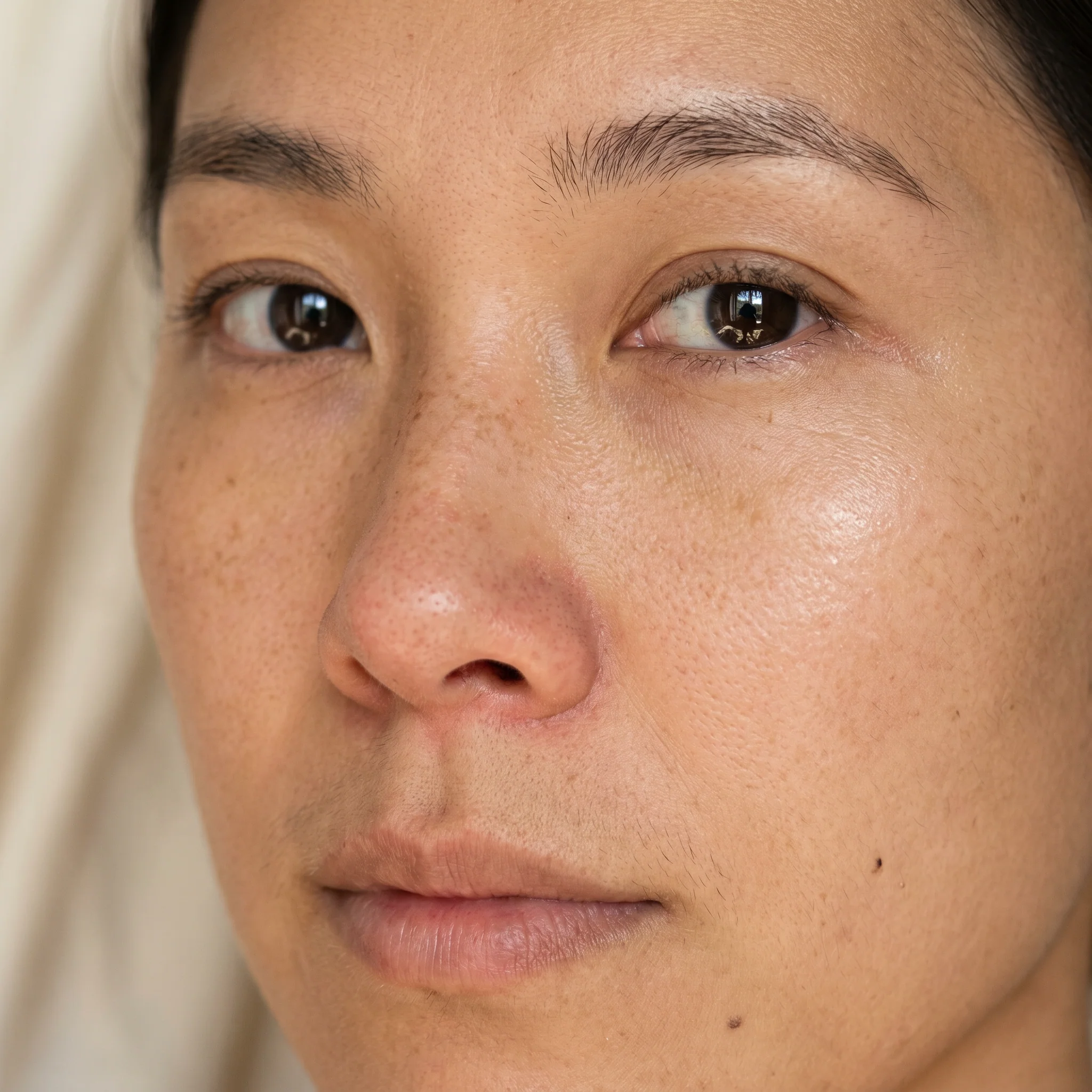
Extreme close-up macro beauty portrait of a 27-year-old East Asian Brazilian
woman (descendant, monolid eyes, warm light-olive skin, freckles scattered
across the nose bridge and cheeks, a tiny mole near the jawline). Micro-level
skin detail: clearly visible pores and fine microtexture across the cheeks and
nose, individual baby hairs along the hairline, fine vellus peach fuzz catching
the light, natural fine lines, subtle uneven pigmentation, slight natural
redness around the nostrils, a faint natural oil sheen on the high points,
non-repeating organic skin marks, realistic subsurface light scattering through
the skin, slight facial asymmetry. Eyes with detailed iris striations,
individual eyebrow hairs, lower lashes visible, small sharp specular catchlights.
Minimal natural makeup, dewy but not glossy finish. Soft cream backdrop.
Lighting: soft diffused beauty light, frontal key just above the eyes with a low
under-chin clamshell fill (butterfly nose shadow, dual catchlights top and
bottom of the iris). Shot on a Canon EOS R5, 100mm macro lens, f/2.8,
razor-sharp focus on the eyes with gentle focal falloff toward the ears, subtle
sensor grain. Beauty editorial realism, unretouched skin look. Avoid: plastic
skin, waxy skin, over-smoothing, airbrushing, beauty filter, poreless, flawless
skin, porcelain skin, AI glow halo, perfect symmetry, cartoon, 3D render.
Reference · 2K · 1:1.
Black-and-white analog film portrait
Peak sophistication without a reference. The secret is naming the film stock as an optical signature: Kodak Tri-X 400 B&W, high contrast, pronounced grain, halation. The model follows film references to the letter: asking for Tri-X + Rembrandt + Leica M6 pulls from the bank of real analog photos, not from the bank of synthetic images. Black and white with grain and age wrinkles beats the uncanny valley completely.
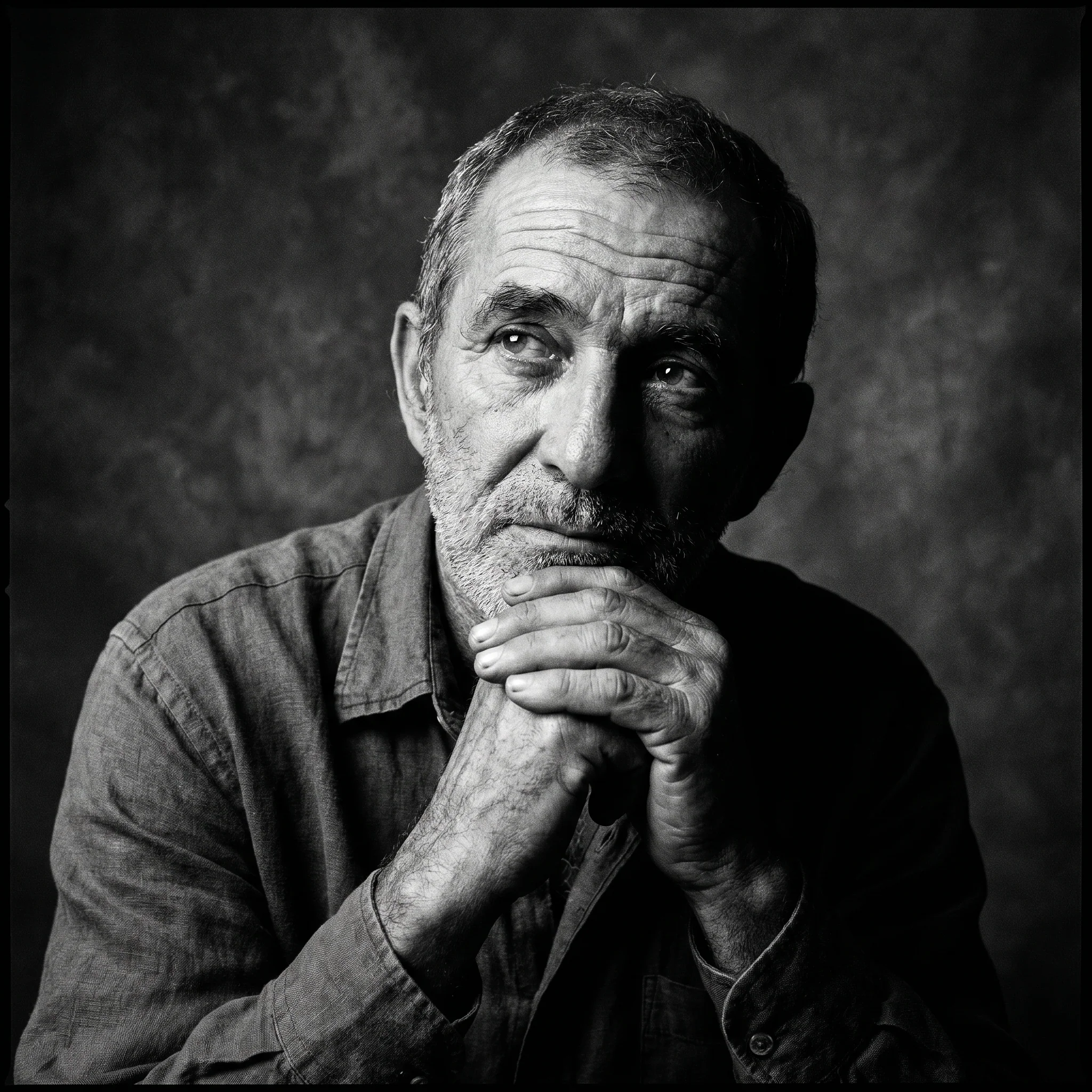
Black-and-white 35mm film portrait, three-quarter framing, of a 60-year-old
mixed-race Brazilian man with weathered brown skin, deep forehead creases,
graying stubble, heavy laugh lines, a worn lived-in texture to the skin, kind
tired eyes, slight facial asymmetry. Natural skin texture with visible pores,
deep wrinkles, sun damage, individual stubble hairs, no smoothing. Contemplative
expression, eyes slightly downcast lifting toward the lens, weathered hands
resting near the chin, wearing a worn linen shirt with natural creases. Dark
mottled studio backdrop. Lighting: single hard-ish key in Rembrandt pattern,
45-degree side key slightly above eye level camera-left, small triangle of light
on the shadowed far cheek, half the face dropping into deep shadow, a single
sharp catchlight in the visible eye, moody chiaroscuro. Shot on a Leica M6 35mm
rangefinder, 50mm Summicron lens, f/2, shallow depth of field. Kodak Tri-X 400
black-and-white film stock, high contrast, deep rich blacks, pronounced
authentic film grain, soft highlight roll-off, slight halation around the
brightest highlight, classic analog tonality. Fine-art documentary portrait,
captured-moment realism. Avoid: digital smoothness, plastic skin, waxy skin,
airbrushing, AI glow, perfect symmetry, HDR, color, 3D render, CGI.
Reference · 2K · 1:1.
D. The same face across different photos (consistency)
This is the technique that separates having an AI influencer from having a bunch of loose photos: keeping the same face photo after photo. Every example below needs a reference: you attach the face image to the card (up to 4) and the Reference model edits on top of it instead of redrawing from scratch.
Before any scene, you save an anchor image: the base photo that defines the face. This is the one I generated to lock in the character for this guide.
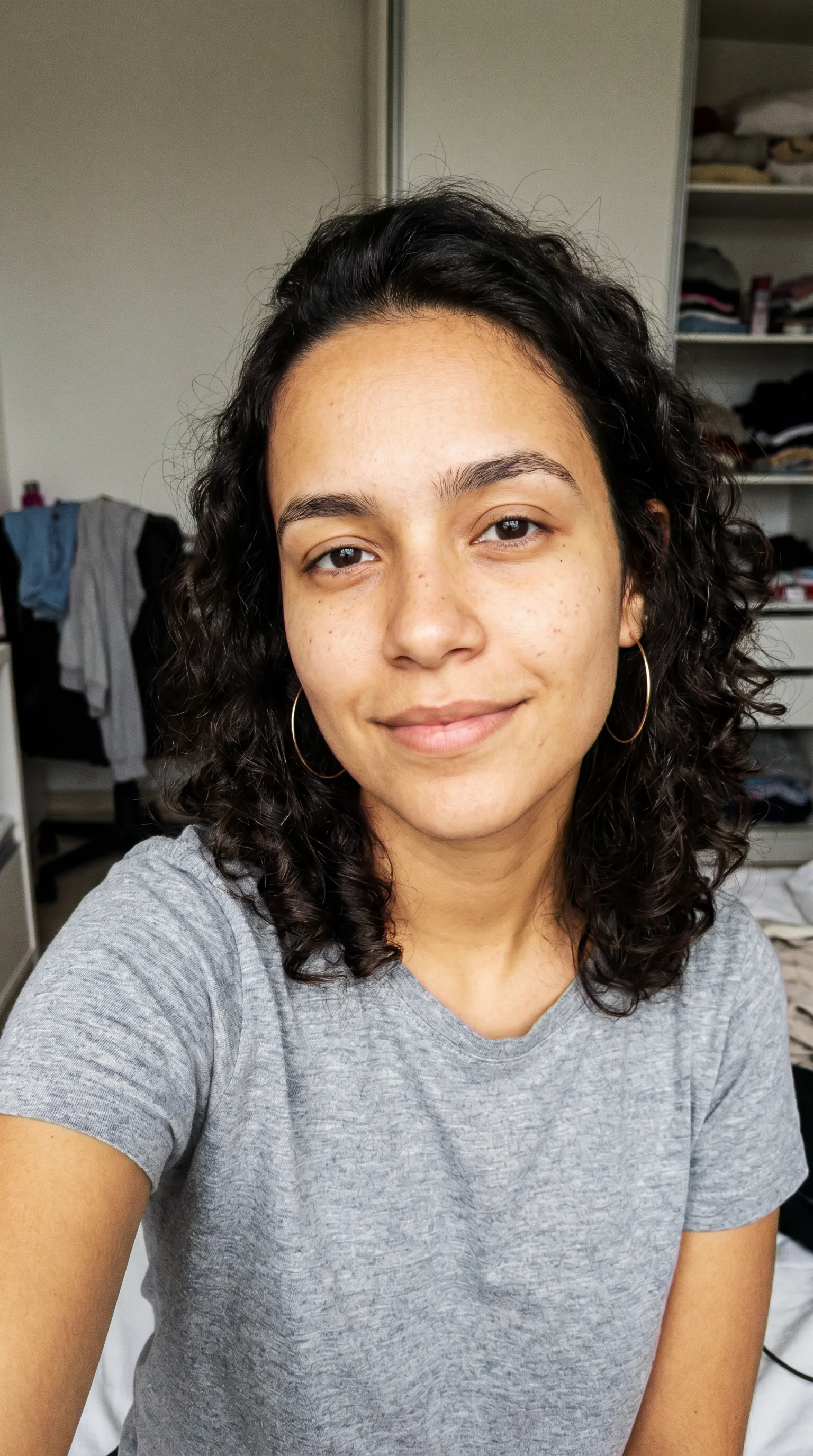
Her prompt is the guide's base formula applied to a new face, still without a reference; this is the generation that creates the reference:
Front-camera iPhone selfie portrait, head and shoulders, of EXACTLY ONE young
23-year-old Brazilian woman alone, naturally very pretty in a girl-next-door
way, the prettiest girl from your neighborhood, youthful fresh face, full lips —
but a REAL person not a model composite: subtle natural facial asymmetry, one
eye a touch smaller than the other, slightly uneven eyebrows, visible pores, a
few faint irregular freckles of different sizes, real-people proportions NOT
golden-ratio symmetric. golden tan skin, shoulder-length dark loose curly hair,
thin gold hoop earrings, looking at the camera with a relaxed friendly neutral
expression.

Arm-length selfie geometry: mild front-camera wide-angle distortion, one
shoulder slightly higher, casual handheld angle slightly above eye level.

Soft window daylight, amateur smartphone photo signature: Smart-HDR processed
look with lifted flat shadows and dull compressed highlights, slightly
washed-out contrast, over-sharpened crunchy fine detail, background only
slightly soft with busy bokeh from a small phone sensor NOT creamy blur, subtle
luminance grain, imperfect white balance, casual slightly tilted framing.
Ordinary bedroom slightly soft behind her.

Looks exactly like a real unedited selfie photo from a phone camera roll, the
photo itself only.

no professional photography, no DSLR, no portrait-lens compression, no rim
light, no film emulation, no cinematic color grading, no perfect facial
symmetry, no model bone structure, no stamped freckles, no second person, no
other people in the frame, no waxy skin, no airbrush, no 8k, no cinematic, no
hyperrealistic, no flawless skin, no middle-aged woman, no mature face, no aged
skin, no camera app interface, no UI elements, no timestamp, no text overlay
Reference · 2K · 9:16.
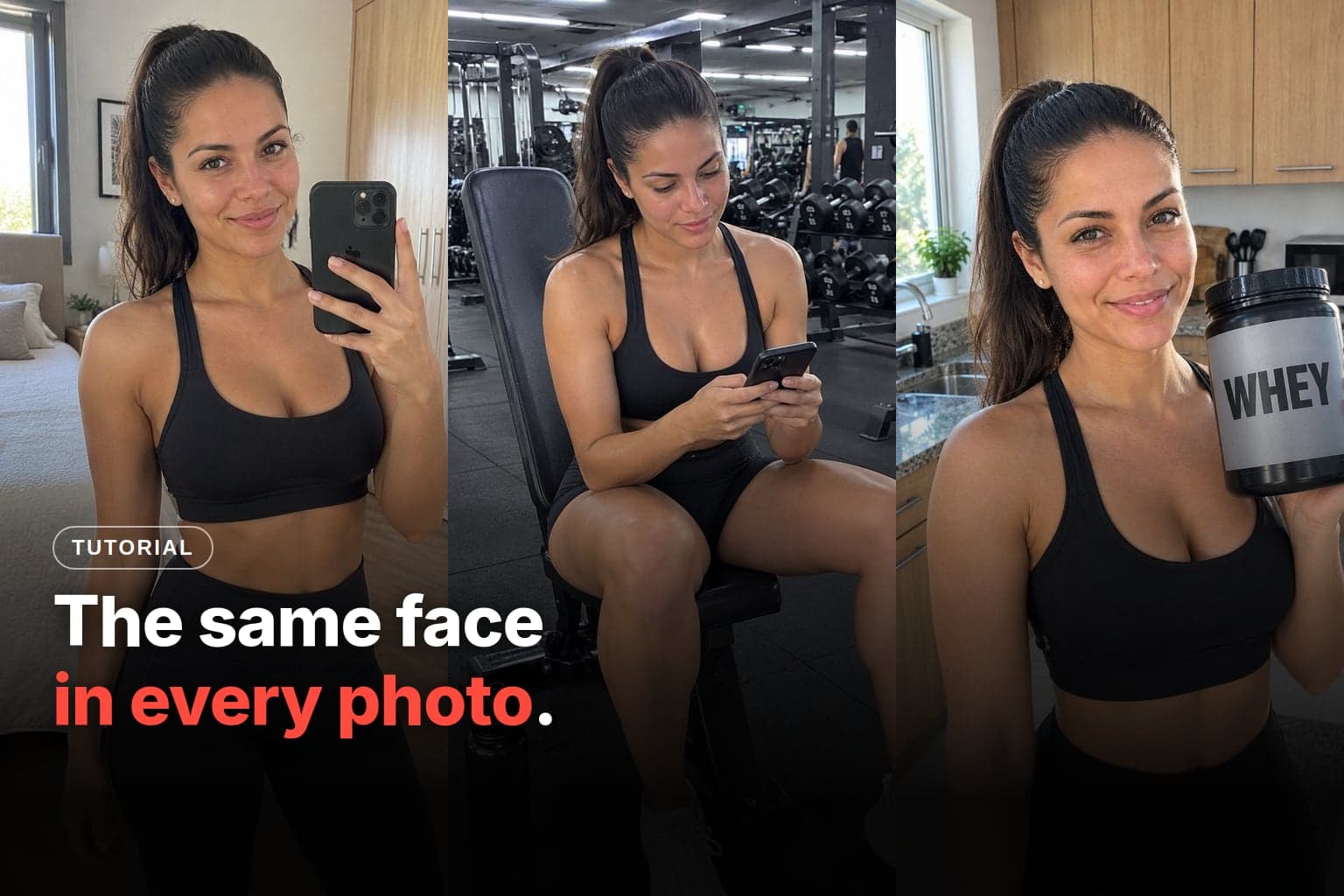
The proof: it's the same person in all three
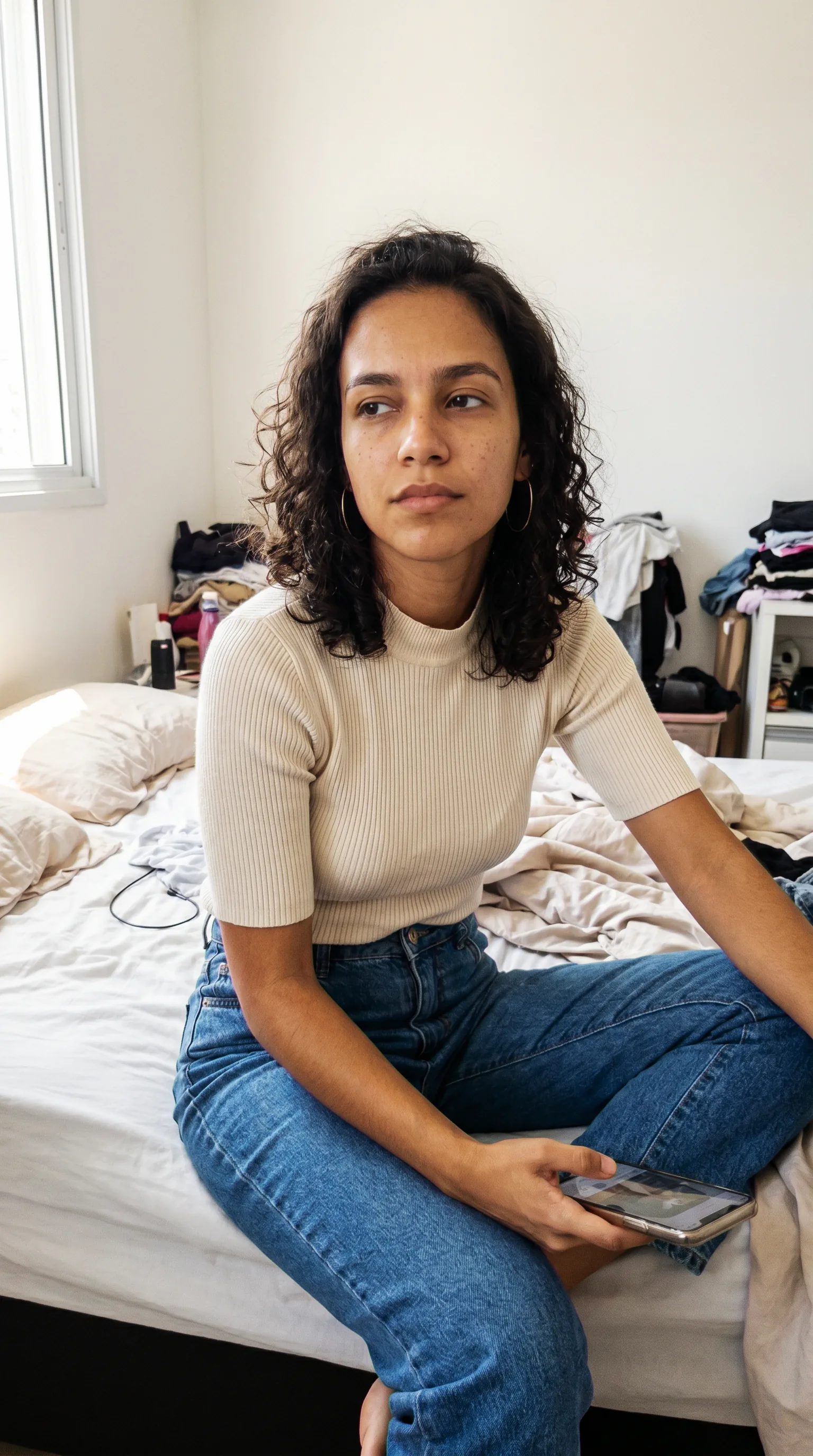
Here's the anchor turning into other photos. I attached the same image as a reference and changed only the scene and the outfit. Notice: same tan skin, same curly hair, same eyebrows, same hoop earrings, in three completely different settings.
First, the same person sitting on the bed in a new outfit, looking toward the window light:
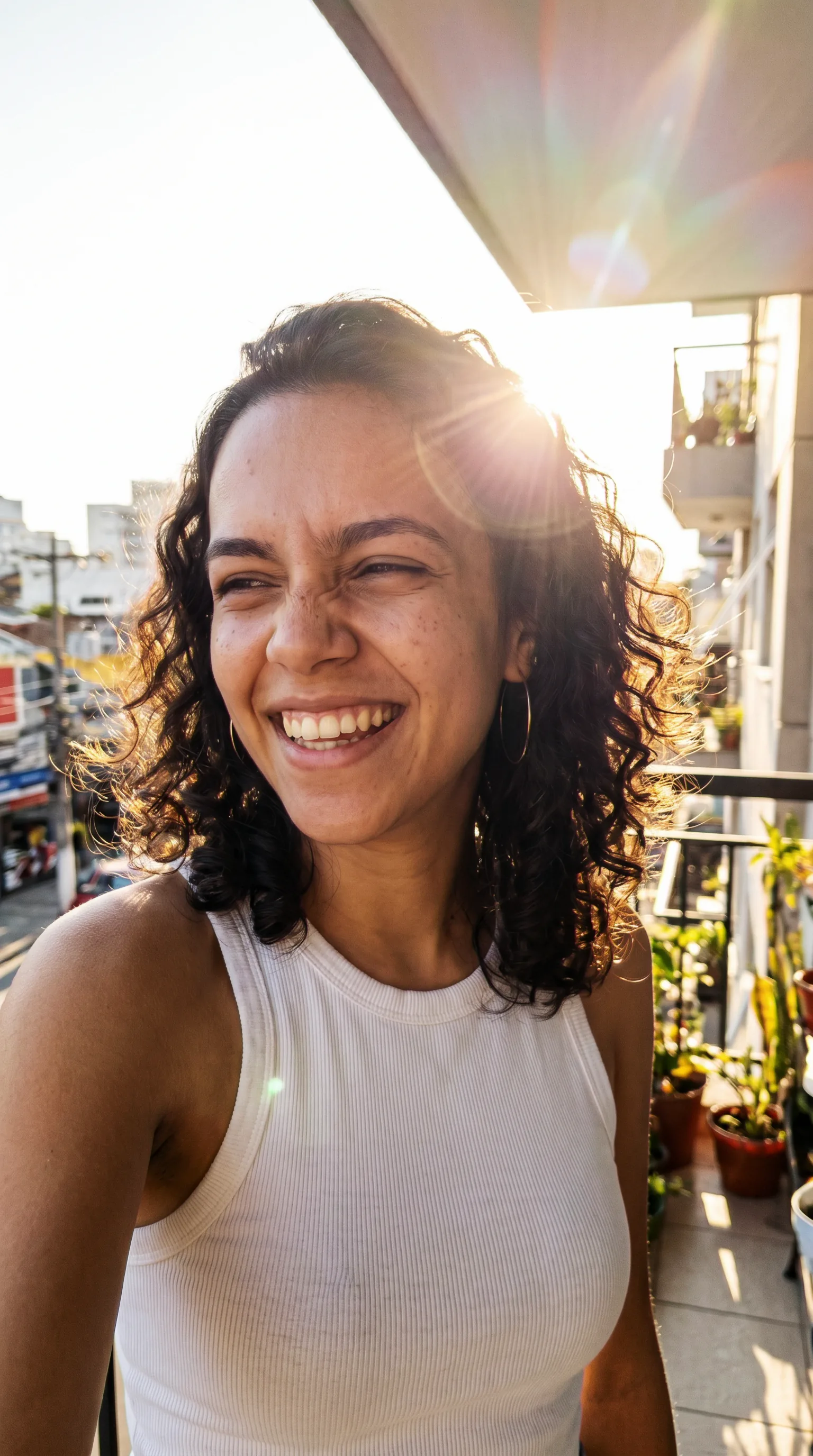
Now the same person in a late-afternoon portrait on a balcony, laughing and squinting against the sun. The flare and the blown-out light came from golden-hour physics and the way a real phone behaves against the sun, not from the word "cinematic":
Reference · 2K · 9:16 · with a reference image.
The portrait prompt is the same template shown below; only the scene block changes (an excerpt of the real prompt):
New scene: the same character outside on an apartment balcony at golden hour,
low warm sun coming from behind her, she squints slightly laughing at someone
off-frame, hair catching the wind, wearing a simple white tank top. Real phone
behavior against the sun: blown-out highlights around the sun side, lens-flare
smear across a corner, her face slightly underexposed with HDR lifting the
shadows flat
The technique that locks this in is repeating the 3 most distinctive traits word for word in every generation. The text restates what does NOT change (same character, 100% identical facial features) and separates what does change (now wearing X, new scene). Swapping a single color word between one photo and the next is enough to make the face slip.
Same character as the reference image. Keep the person exactly as shown with
100% identical facial features, bone structure and skin tone. This is the same
recurring character across posts — do not change her identity, do not beautify,
do not slim the face, do not change age. Only change the outfit, pose and scene.
If the text below disagrees with the reference photo, follow the photo.

Reaffirm her 3 signature traits verbatim every generation (FILL IN with the 3
most distinctive traits of YOUR anchor character — keep these EXACTLY the same
wording every time, never swap a color word, or the face will drift):
[PLACEHOLDER — e.g. "golden tan skin, shoulder-length dark loose curly hair,
thin gold hoop earrings"].

New scene and wardrobe: the same character sitting on the edge of an unmade bed
in a sunlit bedroom in the late morning, now wearing a cream ribbed knit top and
high-waisted jeans, casually holding her phone, looking toward the window light,
relaxed candid moment caught mid-gesture, not posing.

Camera: amateur smartphone photo signature: Smart-HDR processed look with lifted
flat shadows and dull compressed highlights, slightly washed-out contrast,
over-sharpened crunchy fine detail, background only slightly soft with busy bokeh
from a small phone sensor NOT creamy blur, subtle luminance grain, imperfect
white balance, casual slightly tilted framing.

Skin and realism: visible pores, fine micro-texture, baby hairs along the
hairline, faint natural redness on the cheeks, slight facial asymmetry, natural
subtle oil sheen. Looks exactly like a real unedited photo from a phone camera
roll.

no professional photography, no DSLR, no portrait-lens compression, no rim
light, no film emulation, no cinematic color grading, no perfect facial
symmetry, no model bone structure, no stamped freckles, no second person, no
other people in the frame, no waxy skin, no airbrush, no 8k, no cinematic, no
hyperrealistic, no flawless skin, no middle-aged woman, no mature face, no aged
skin, no camera app interface, no UI elements, no timestamp, no text overlay
Reference · 2K · 9:16 · with a reference image.
You in a new scene
The same technique works with YOUR face. You upload 1 to 3 of your own selfies as a reference and the model puts you in any scene. Here I uploaded the headshot of the salt-and-pepper man from earlier and asked for a canyon overlook in the late afternoon: it's the same man, now traveling, without ever leaving home.
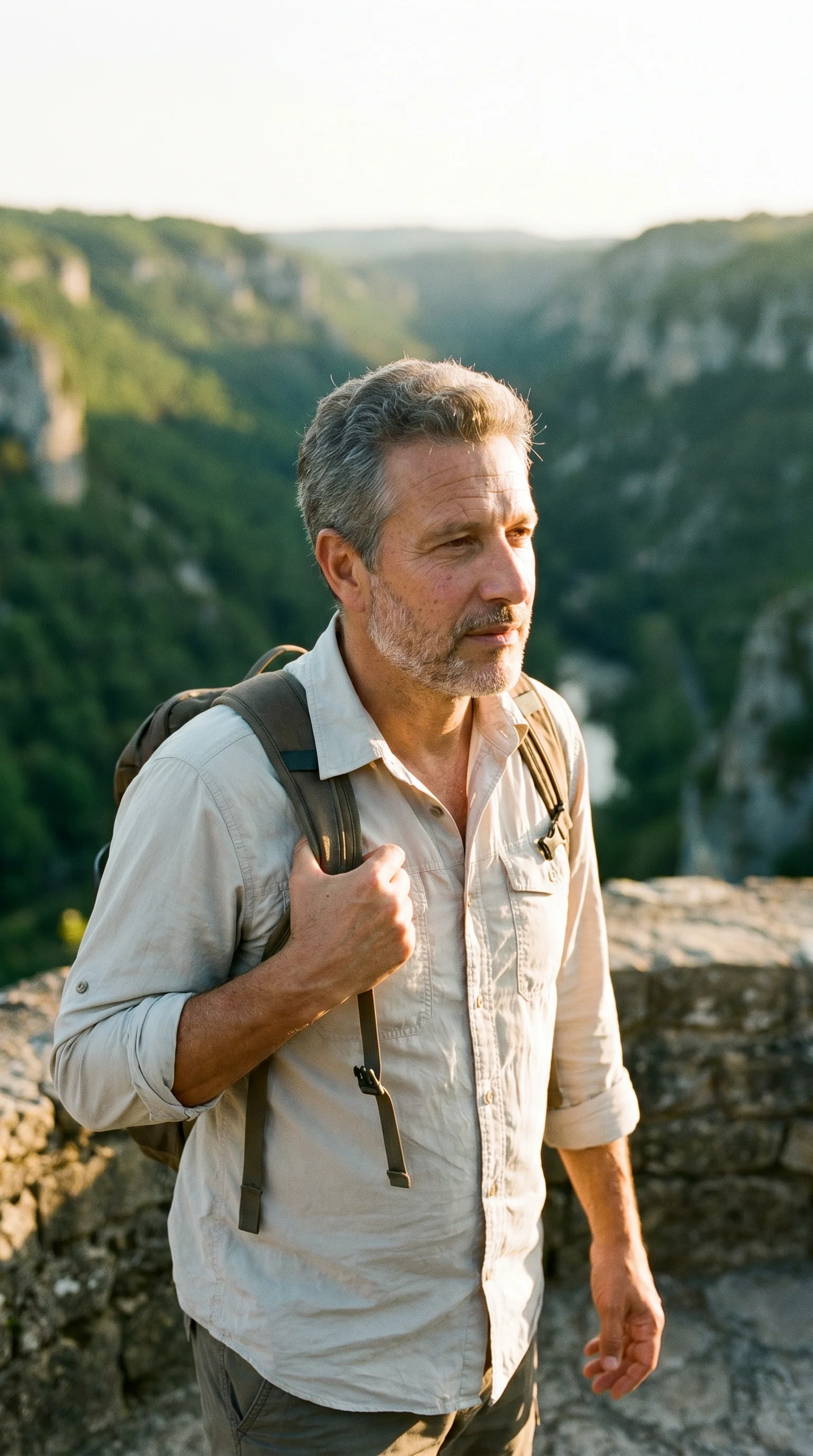
The golden rule here: the reference instruction comes FIRST in the prompt, before the scene, because the model edits on top of your photo and its attention goes to the face when the face comes up at the start. And you replace the [PLACEHOLDER] with YOUR real traits: describing traits that don't match your selfie makes the text fight the photo, and the face drifts.
REFERENCE INSTRUCTION (use this exactly): Use the uploaded photos as the face
reference. Same person as the reference image, keeping the person's face exactly
as shown with 100% identical facial features, bone structure, skin tone and
unique marks. Do not beautify, do not slim the face, do not change age, do not
change gender, do not change hairstyle unless asked.

Reaffirm the reference traits verbatim (FILL IN with 2-3 of YOUR OWN most
distinctive traits taken from your uploaded selfie, so the text never
contradicts the photo): [PLACEHOLDER — e.g. "medium-deep warm skin tone, thick
natural eyebrows, small scar on the left cheek"]. Match my real skin tone and
real hair exactly as in the reference — if the text and the photo disagree,
follow the photo.

Scene: the same person standing on a stone overlook in a green canyon landscape
at golden hour, light hiking shirt slightly wrinkled and untucked, one hand
resting on a backpack strap, looking off to the side mid-step, not posing for
the camera. Late afternoon sun coming from the right, warm tone, long soft
shadows falling left, a faint rim light tracing the shoulder and hair.

Camera: shot on a Sony A7 III, 35mm lens, f/2.8, shallow depth of field, the
canyon valley softly blurred behind. Kodak Portra 400 film emulation, subtle
film grain, accurate warm white balance.

Skin and realism: natural skin texture with visible pores and fine micro-texture,
faint laugh lines, slight facial asymmetry, a little natural oil sheen on the
forehead and nose, catchlights in the eyes, detailed iris. Candid travel
snapshot, looks like a real photo taken by a friend, natural color grading, no
studio lighting, no AI render look, no smoothing, no beauty filter, no plastic
skin, no perfect symmetry, no airbrushing.
Reference · 2K · 9:16 · with a reference image.
Swap the face in a scene you already like
The most advanced technique, and the one that closes the guide. You have a scene you already like (body, outfit, background, light) and want to put a different face in it. I took the luxury car photo from earlier (the woman with the bun leaning on the white car) as the target scene and swapped in the anchor influencer's face. Look at the result: the whole scene stayed the same (same car, same pose, same outfit, same mansion, same light) and only the face changed.
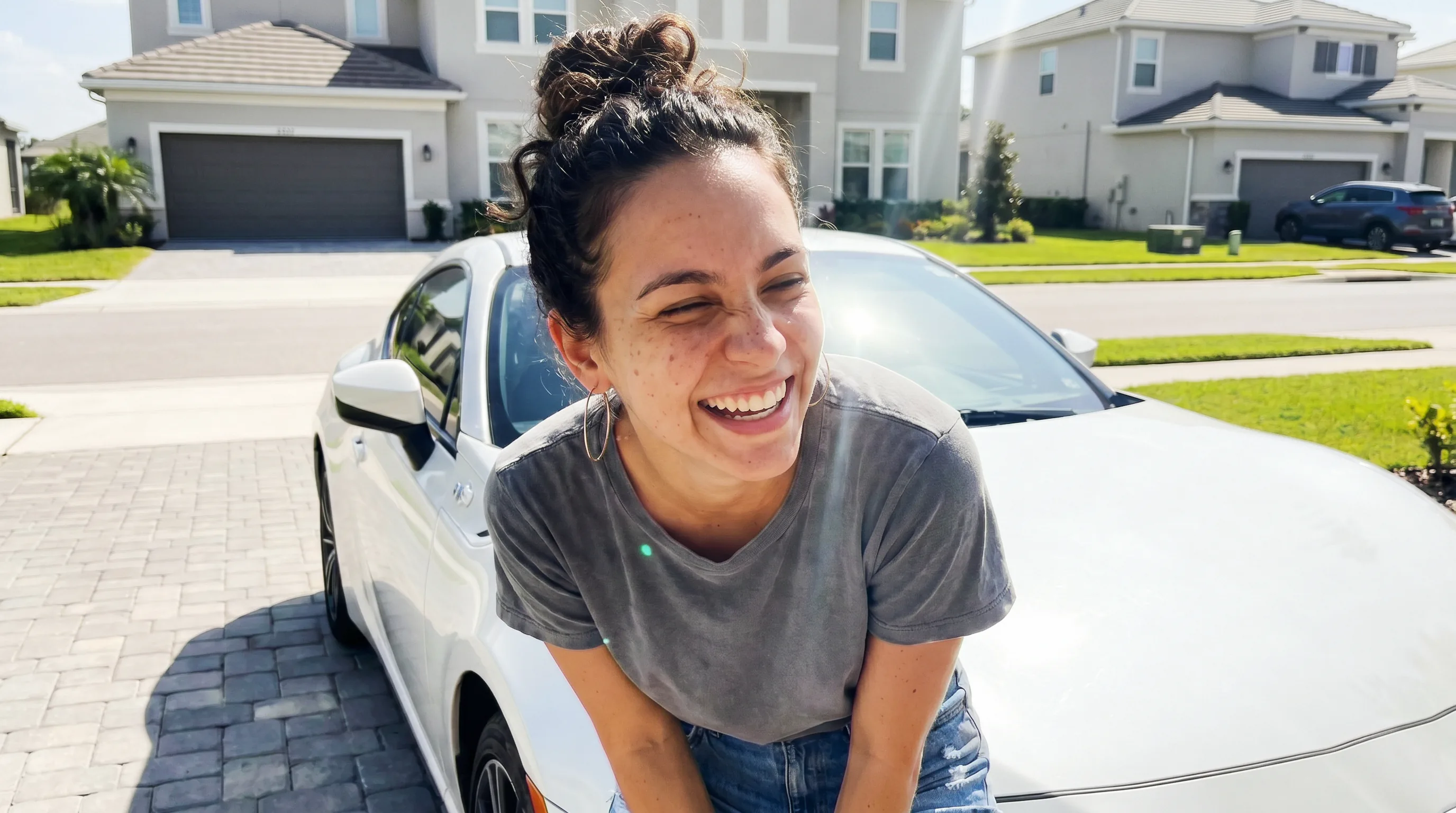
The secret isn't just swapping the face. It's matching the new face's physics to the scene's: same light direction, same depth of field, same grain, catchlights lining up with the scene's light source. Without that, the face looks pasted on and floating, the classic giveaway of a bad swap. You attach TWO images: the face reference first, the target scene second.
You are given TWO images. Image 1 = FACE REFERENCE (the identity to use). Image
2 = TARGET SCENE (the body, outfit, pose, background and lighting to keep).

Replace the face in the TARGET SCENE (Image 2) with the person from the FACE
REFERENCE (Image 1). Keep 100% identical facial features, bone structure, skin
tone and unique marks from Image 1 — do not beautify, do not slim, do not change
age or gender. Keep everything else from Image 2 unchanged — same body, same
outfit, same pose, same background, same camera angle and the same lighting
direction. Blend the new face naturally into the existing harsh midday light of
Image 2 so skin tone and hard shadows match the scene.

Reaffirm the face-reference traits verbatim (FILL IN with 2-3 real traits of the
face in Image 1, so the text matches the reference and never fights it):
[PLACEHOLDER — e.g. "golden tan skin, shoulder-length dark loose curly hair,
thin gold hoop earrings"]. If the text and Image 1 disagree, follow Image 1.

Match the scene's optics so the swap reads as one real photograph: same depth of
field, same washed Smart-HDR contrast and grain as Image 2, visible pores,
slight facial asymmetry, she keeps squinting against the bright light exactly as
in Image 2. The result must look like a single real phone photo, not a
composite.

no smoothing, no plastic skin, no airbrushing, no visible blending seam around
the jaw and hairline, no beautifying, no studio look
Reference · 2K · 16:9 · with 2 reference images.
Heads up: the consistent-face examples have a
[PLACEHOLDER]inside the prompt. You HAVE to replace it with your real traits (or your character's). If you copy the example as is, the model tries to paste in the example's traits, which aren't yours, and the face comes out wrong. And re-attach the reference every 5 to 8 generations: over a long sequence the face gradually slips, and uploading the base photo again puts the identity back in place.
The mistakes that most give away an AI photo
After generating all 19, these are the slip-ups that hurt realism the most:
- Asking for "8k cinematic hyper-realistic". It's the number one mistake. Those words pull in render glow and waxy skin. Describe a real camera, not a quality adjective.
- Light with no source. "Professional lighting" turns into that flat light coming from everywhere. Say where the light comes from, in which direction and at what temperature.
- Skin that's too smooth. If you don't ask for pores, oiliness and asymmetry, the model hands you a doll's face. The flaw is what looks human.
- Forgetting the negatives. Without
no plastic skin, no smoothingat the end of the prompt, the plastic sheen comes back. - Setting an aspect ratio the model doesn't honor. 4:5 and 3:2 fall back to 16:9. Use only 9:16, 1:1 or 16:9.
- Trying for consistency without a reference. The model doesn't memorize your character's face; the image you attach is what holds the identity. Without it, you get a different person.
Start creating your AI photos
Open the Image card in the Workflow, pick the quality and one of the three aspect ratios, build the prompt with the four ingredients (real camera, light with a source, skin with texture, negatives) and generate. To repeat the same face, attach the reference and re-anchor every few generations.
There are 5,674 creators on the platform, which runs the Reference model and the rest of the stack (other image models such as Creative, and video models such as AI Video 1 and AI Video 7). You can follow this same workflow with the interface in English and more than 15 tools in a single account:
Frequently asked questions
What's the best prompt for a realistic AI photo?
There's no magic phrase; there's a four-ingredient formula. Describe a real camera (a phone for casual shots, or a camera with a lens and film stock for studio work), light with a source, direction and temperature, skin with texture (pores, oiliness, asymmetry) and the negatives at the end (no plastic skin, no AI render look). The prompts in this guide are ready-made examples for each type of photo.
Why do my AI photos look like plastic?
Almost always because the prompt asks for "8k", "cinematic" or "flawless": those words pull in render glow and smoothing. The fix is the opposite: ask for skin with flaws (pores, oiliness, asymmetry) and finish with explicit negatives against plastic skin and smoothing.
Can you keep the same face across multiple AI photos?
Yes. Save an anchor image of the face and attach it as a reference (up to 4 images) to every generation in the Workflow card. The Reference model edits on top of that image and keeps the identity. Re-attach the reference every 5 to 8 generations so the face doesn't drift.
How much does it cost to generate a photo with the Reference model?
Each generation costs 18 credits in Avatrix at 1K and 20 at 2K. Higher quality settings render more skin and texture detail, which is recommended when the photo shows skin or fabric up close.
Which aspect ratios does the Reference model accept in Avatrix?
In practice, three: 9:16 (portrait, for full-body shots of people), 1:1 (square, for close-ups and headshots) and 16:9 (landscape, for products, food and real estate). The card offers more options, but the rest (4:5, 3:2, 3:4…) fall back to 16:9 at generation time.