Yes. TikTok Shop allows AI-generated content as long as it's honest and labeled: the rule says so in both the US and the Brazil editions of the TikTok Shop Academy, dated September 2026. What gets a video taken down, and can cost you your commission, is deception: showing a product different from the one for sale, imitating a real person, posing as a doctor or promising results. To become an affiliate, you need to be 18 and have 1,000 followers in both markets we checked, but the details change from country to country.
This guide pulls together TikTok Shop's official rules, checked on October 29, 2026: the AI rule for the US and for Brazil, US eligibility, and the Brazil Academy's affiliate, commission and content policies. Wherever a number comes from one specific market, we say which. The video part uses the tools of Avatrix, which wrote this guide, with screen and button names as of October 2026.
Can you use an AI influencer on TikTok Shop?
Yes. The page AI-Generated Content Restrictions and Requirements, in TikTok Shop's Brazil Academy, sums up the rule in one line: "AI-generated content is allowed, but you must be honest." The same page, dated September 20, 2026, says content "will not be restricted or penalized solely for using AI," as long as it follows the rules. The US Academy publishes its own version of the rule, dated September 2, 2026, on the same principle: AI content is allowed, but you must be "transparent and accurate" (both checked October 29, 2026).
An AI influencer is exactly the case where the platform demands the most transparency. The Brazil page says disclosure is especially important when a video includes "synthetic faces, voices, digital humans, or highly realistic virtual figures." A character built to look like a real person needs a label.
The TikTok Shop Content Policies, dated July 1, 2026, say the same thing in item 3.1: "AI-generated content is not allowed if it" misleads viewers or impersonates other people (checked October 29, 2026).
What are the TikTok Shop affiliate requirements?
They depend on the country where you promote products. The table shows Brazil's, and the US requirements come right after it.
| Requirement | What applies in Brazil | Official source |
|---|---|---|
| Age | 18 or older | Creator Eligibility Policy (July 1, 2026) |
| Followers | At least 1,000 on your TikTok account | Same policy |
| Identity | Name, date of birth, CPF (the Brazilian taxpayer number) and a Brazilian ID (RG, CNH or RNE/CRNM) | Same policy |
| Account | Follow the Community Guidelines, have no prior revocation of e-commerce permissions, and not be a government, politician or political party account | Same policy |
| Market | The policy covers creators promoting products for sale in Brazil | Same policy |
| Getting started | Under 2,000 followers, a 30-day pilot with up to 10 product videos a day. The cap lifts after 30 days and 2,000 followers | Pilot program (July 9, 2026) |
| Before 1,000 | Linkshare: an affiliate link that earns commission, available after PKYC (age verification) | Linkshare (July 24, 2026) |
Sources checked on October 29, 2026. The dates in parentheses are the ones shown on each page.
In the US. The Creator Eligibility Policy (September 25, 2026) also asks for 18+ and 1,000 followers, and you must be based in the United States. Creators under 5,000 followers are automatically enrolled in a pilot for at least 30 days, with up to 3 shoppable product videos a day and 3 shoppable LIVEs a week. You graduate after 30 days with 5,000 followers, and TikTok may ask for a government ID after your first commission (checked October 29, 2026).
How to apply. In the app, go to Profile, tap the three-line menu, open TikTok Studio and go to TikTok Shop for Creator. The app shows the list of requirements and the button to apply. After approval, you verify your identity by uploading your ID and address in the Verification Center. Without that step, you can't earn or withdraw commission (How to Apply as an Affiliate Creator, Brazil Academy, October 14, 2026, checked October 29, 2026).
One detail that matters for an AI influencer: the verification is yours, not the character's. TikTok asks for your ID (in Brazil, your CPF and your document). The influencer is the face of the profile, and you're the one accountable for the affiliate account.
What's banned in an AI video on TikTok Shop?
| Banned | Example from the rule itself | Where it is |
|---|---|---|
| Fabricating, modifying or exaggerating the product | "The product shown must accurately match the product being sold" | AI rule |
| Using a real person's face, voice or name | Imitating another person's identity, appearance or voice. Using someone's likeness without express permission | AI rule and Content Policies, item 3.7 |
| Fake expert | AI-made "doctors" or "professors." A digital human in a news-broadcast or lecture format vouching for a health product | AI rule |
| Promising results | "This product removes acne in only a few days." A shampoo that "instantly grows hair" | Content Policies, item 3.10.2, and AI rule |
| Misleading before-and-after | Wrinkles disappearing after using a cream | Content Policies, item 3.10.2 |
| Absolute claims without proof | "100% Natural," "NO.1 Product," "the cheapest" with nothing to back it up | Content Policies, items 3.10.2 and 3.10.3 |
| Video with no demonstration | A creator who doesn't speak, interact with viewers or demonstrate the product | Content Policies, item 3.13 |
| Weight-loss products | "TikTok Shop does not allow the promotion of weight loss and fat-reduction products" | Content Policies, item 3.15 |
Rules checked on October 29, 2026, in the Brazil Academy. Each market publishes its own policies, so check the ones for your country.
What happens if you break them: at the video level, the AI rule provides for limited reach, removal of the product link and lost points on your Creator Health Rating. At the account level, it starts with a warning for a first minor violation. If it happens again, you can face posting limits, permanently disabled commission withdrawals, suspension and, in severe cases, a ban.
Is showing the AI influencer holding the product a fake demonstration?
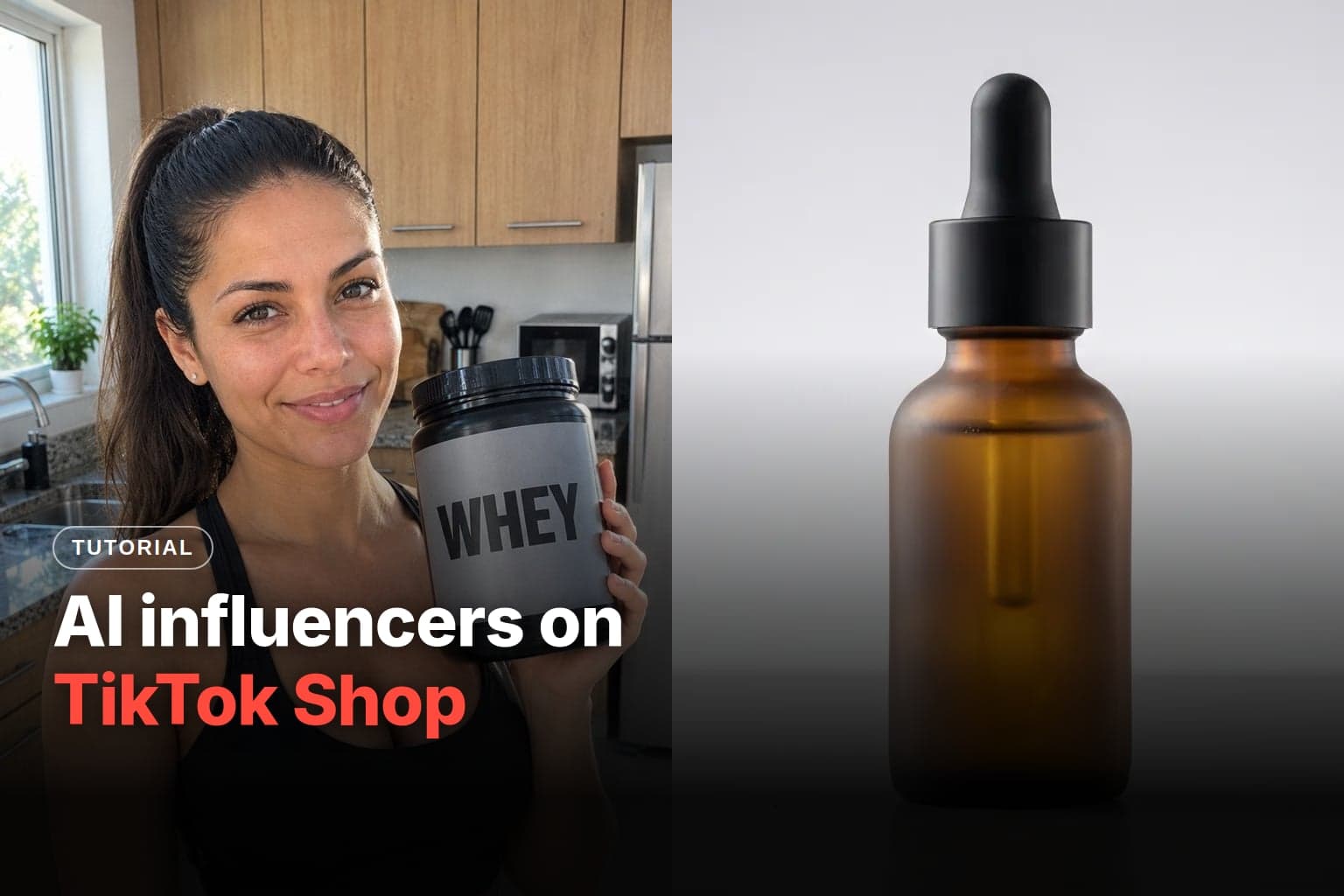
No, as long as it's the same product as the listing and the use shown is real. The AI rule allows "using AI to generate virtual scenes, diagrams, or animations to illustrate the proper use of a product." What it bans is a product that doesn't match what's for sale: changing its size, color, shape or function, turning a flat product into fake 3D, or adding glow and effects the product doesn't have.
Translating scripts and generating dubbing, subtitles and narration with AI are also on the list of what's allowed.
How do you label a video made with AI?
TikTok's Community Guidelines, which apply in every country, already "require creators to label AI-generated or significantly edited content that shows realistic-looking scenes or people" (current version effective September 24, 2026, checked October 29, 2026). On TikTok Shop, there are two ways to do it, and you can use both:
- When you post: turn on the "AI-generated content" setting. The video gets the "Disclosed by creator as AI-generated" label in the bottom-left corner.
- In the video itself: on-screen text, a watermark, a sticker or a note in the caption.
If the file carries technical AI metadata, TikTok adds an "AI-generated" label on its own, and you can't remove that one. Mislabeling is also a violation: marking something as AI when it isn't, or failing to mark it when AI played a significant role.
Can a brand refuse AI influencer videos?
Yes, and some already do. According to a Wall Street Journal report cited by Affiverse in July 2026, SharkNinja warned affiliates they would lose their commission if they promoted its products with AI content, and Rare Beauty said it doesn't work with AI-generated creators (checked October 29, 2026). If a brand has its own rule, it applies on top of TikTok's.
What about the US video rules?
In the US, the TikTok Shop Academy has an extra document, Requirements for High-Quality Videos and LIVEs. It asks for videos recorded in a real-world environment, with camera movement, the creator's face and the physical product, and it bans AI-generated voices in LIVEs. The page applies to the United States, and we didn't find a version of it in the Brazil Academy on October 29, 2026. If you sell in the US, it's the rule that most affects an AI influencer. Read it before you post.
How does TikTok Shop affiliate commission work?
Commission is the Commission Base × rate. The seller sets the rate. The base is what the buyer paid plus any platform subsidy. In the Academy's own example, from the Brazil edition and in Brazilian reais, a R$100 purchase with a R$10 subsidy becomes a R$110 base. At 10%, the commission is R$11 (Affiliate Commission for Creators, checked October 29, 2026). The timelines below come from the same Brazil Academy.
- When it's paid: after the seller's order is settled. Settlement takes 7 calendar days on the standard type, 3 on express and 15 on extended.
- When it isn't: orders canceled before shipping, refunded after the sale or suspected of fraud. A partial refund cuts the commission in the same proportion.
- On Linkshare: attribution lasts 14 days and the link stays valid for up to 100 days. If the buyer purchases the product you showed, you usually receive 100% of its commission. If they buy a different product the platform recommended, about 50%.
To find out whether this can turn into income, run the math of views × click rate × conversion × order value × commission, with three example scenarios, in the guide how much an AI influencer earns.
How do you sell on TikTok Shop with an AI influencer, step by step?
There are seven steps. The first four happen before you generate a single image.
1. How do you set up the AI influencer's profile?
Her own account, just for her, with a name, profile photo and bio that share the same identity. Say in the bio that she's a character created with AI. That doesn't replace the label on the video, but it keeps people who land on the profile from feeling fooled.
The face has to be the same in every post. An influencer who keeps changing faces never becomes a reference for anyone. The step-by-step for keeping the same face is in the guide to creating an AI influencer without showing your face.
2. How do you choose the niche?
A niche that sells and that the rules allow. Electronics, beauty and health are among TikTok Shop's top categories in Brazil, according to a first-year review published by Meio & Mensagem, a Brazilian marketing trade outlet, in June 2026.
Health calls for care. TikTok Shop doesn't allow promoting weight-loss products, restricts medical claims and bans fake experts. To start with an AI influencer, niches like home, kitchen, organization, phone accessories and beauty without treatment promises are safer. In them, the product explains itself just by being shown.
3. How do you choose the product?
- Look at rate and price together. A $20 product at 10% pays $2 per sale. Do the math before you shoot.
- Read what the listing promises. The video can't promise more than the product page.
- Have the real product photo. It's what goes into the scene, and what shows up in the video has to match what's for sale.
- Pick products you can show in use. The rules ban videos where nobody demonstrates the product.
4. How do you write the script?
Short, showing the product in use and with no promises. The template below fits in up to 10 seconds and uses a sample product. Replace the brackets with what your product's listing says:
SCENE: bright kitchen, window light. The influencer holds the drawer
organizer at chest height, with the label facing the camera, then
fits the organizer into the open drawer.

LINE (up to 10 seconds): "Messy kitchen drawer? This organizer has
[number of compartments the listing states] and fits right in the
drawer. Cutlery on one side, utensils on the other. It's linked in
the cart."

ON-SCREEN TEXT: "Made with AI"

DON'T SAY: "never messy again", "the best one out there", "cheaper
than anywhere else", "I use it every day".
The "don't say" line is there for a reason. The first three are promises or absolute claims without proof, which the Content Policies ban. The last one is an experience the character doesn't have.
5. How do you generate the video of the AI influencer showing the product?
In Avatrix, the path has four steps:
- Characters. Open your influencer's profile and, under Products, tap Add. Upload the product photo, give it a name and fill in "Price, hook or benefit, in one line." Tap Save product.
- Create Image. In the prompt, mention the influencer with @ and pick the product in the Product field. The products from her profile show up there, and you can attach another photo on the spot. The screen warns: "The product replaces the main object in the scene." Ask for a photo of her holding the product at chest height, with the label facing the camera.
- Check the product in the photo. Color, size, shape and label have to match the listing. If the AI changed anything, generate again. Changing the product is exactly what the rule calls fabricating or exaggerating.
- Create Video. On the approved photo, tap Animate, which takes the image to Create Video. Use the Animate photo tab: the photo becomes the first frame of the video. Choose a model with native audio, like AI Video 8, which generates 3 to 10 seconds in 9:16, and write the line inside the prompt.
The generate button shows the cost before you spend anything. In the July 2026 test in the niche AI influencer guide, 10 seconds of video with voice on AI Video 8 cost 150 credits.
| Avatrix tool | What it does in a product video |
|---|---|
| Characters | Stores the influencer and her products in her profile |
| Create Image | Photo of the influencer holding the product, with @character and the Product field |
| Create Video | Animates the photo and adds the line, as a vertical video |
| Workflow | Chains the image card and the video card on a single canvas |
| AI Chat | Makes the product photo through a conversation with an agent, which asks you for the label text |
| Generate Voice | Narration in English, Spanish or Portuguese, or with a cloned voice, to lay over a video in your editor |
The other paths are documented in guides with screenshots. Workflow, with the prompt for the spoken line, is in the niche guide. The product photo made in AI Chat is in the guide to the influencer's first feed.
Avatrix generates the photo and the video. Linking the product, turning on the label and posting happen in the TikTok app.
6. How do you post with the label and the product?
In the TikTok app, when you publish:
- Turn on "AI-generated content" in the post settings.
- Link the TikTok Shop product that appears in the scene, and no other.
- Write a caption with no promises and no "the best" or "the cheapest."
- If you're in the starter pilot, stay under its cap: 10 product videos a day in Brazil, 3 a day in the US.
7. Which metrics should you track?
- Views of each product video.
- Product clicks, to know your click-through rate.
- Orders, to know your conversion rate.
- Commission and refunds, because a returned order wipes out the commission.
- Creator Health Rating, to see whether any video cost you points.
Change one thing at a time: the hook, the scene or the product. With 30 days of data, redo the math with your own numbers.
Which mistakes take down the video or the commission?
- Posting without the AI label. Failing to mark a video when AI played a significant role is a violation.
- Accepting a photo where the AI changed the product. The AI rule requires the product in the video to be exactly the one for sale.
- Promising results. Wrinkles that vanish with a cream, hair that grows instantly and weight-loss before-and-afters are examples the rules themselves ban.
- Creating an AI "doctor" or "nutritionist." Fake experts are a declared enforcement focus, especially for health products.
- Using a real person's face or voice. That goes for celebrities, for people you know and for imitating someone's looks.
- Posting a static video. A photo with text, with nobody talking or showing the product, counts as content with no engagement.
- Promoting weight-loss products. That promotion is banned on TikTok Shop.
- Going over the pilot cap. It's 10 product videos a day in Brazil and 3 in the US until you graduate.
Want to see the flow from product to finished video, with the plans? See Avatrix for TikTok Shop →
Frequently asked questions
Yes. TikTok Shop’s rule on AI-generated content, published in its US Academy (September 2, 2026) and its Brazil Academy (September 20, 2026), says AI content is allowed as long as it’s honest and labeled, and that it isn’t penalized just for using AI. Using AI to fabricate or exaggerate the product, impersonate a real person, create a fake expert or promise results is banned.
1,000 in the two markets we checked, the US and Brazil, plus being 18 or older and passing an ID check. The starter pilot differs: in Brazil, creators under 2,000 followers get 30 days capped at 10 product videos a day; in the US, creators under 5,000 followers are capped at 3 shoppable videos a day for at least 30 days. In Brazil, before 1,000 followers you can earn commission with Linkshare after PKYC (age verification). Other countries set their own rules.
When you post, turn on the “AI-generated content” setting, and the video gets the “Disclosed by creator as AI-generated” label in the bottom-left corner. On-screen text, a watermark, a sticker or a note in the caption also work. If the file carries AI metadata, TikTok adds an “AI-generated” label on its own, and it can’t be removed.
Commission is the Commission Base times the rate the seller sets. The base is what the buyer paid plus any platform subsidy: in the Brazil Academy’s own example, in Brazilian reais, a R$100 purchase with a R$10 subsidy makes a R$110 base, and at 10% the commission is R$11. It’s released only after the order settles, and canceled or refunded orders don’t pay.
Yes, if it’s the same product as the listing and the use shown is real. The rule allows virtual scenes that illustrate the proper use of a product. What it bans is changing the size, color, shape or function, or showing an effect the product doesn’t have.
It depends on how serious it is. At the video level, the AI rule in the Brazil Academy provides for limited reach, removal of the product link and lost Creator Health Rating points. At the account level, it starts with a warning for a first minor violation and, if it happens again, can escalate to posting limits, permanently disabled commission withdrawals, suspension and a ban.