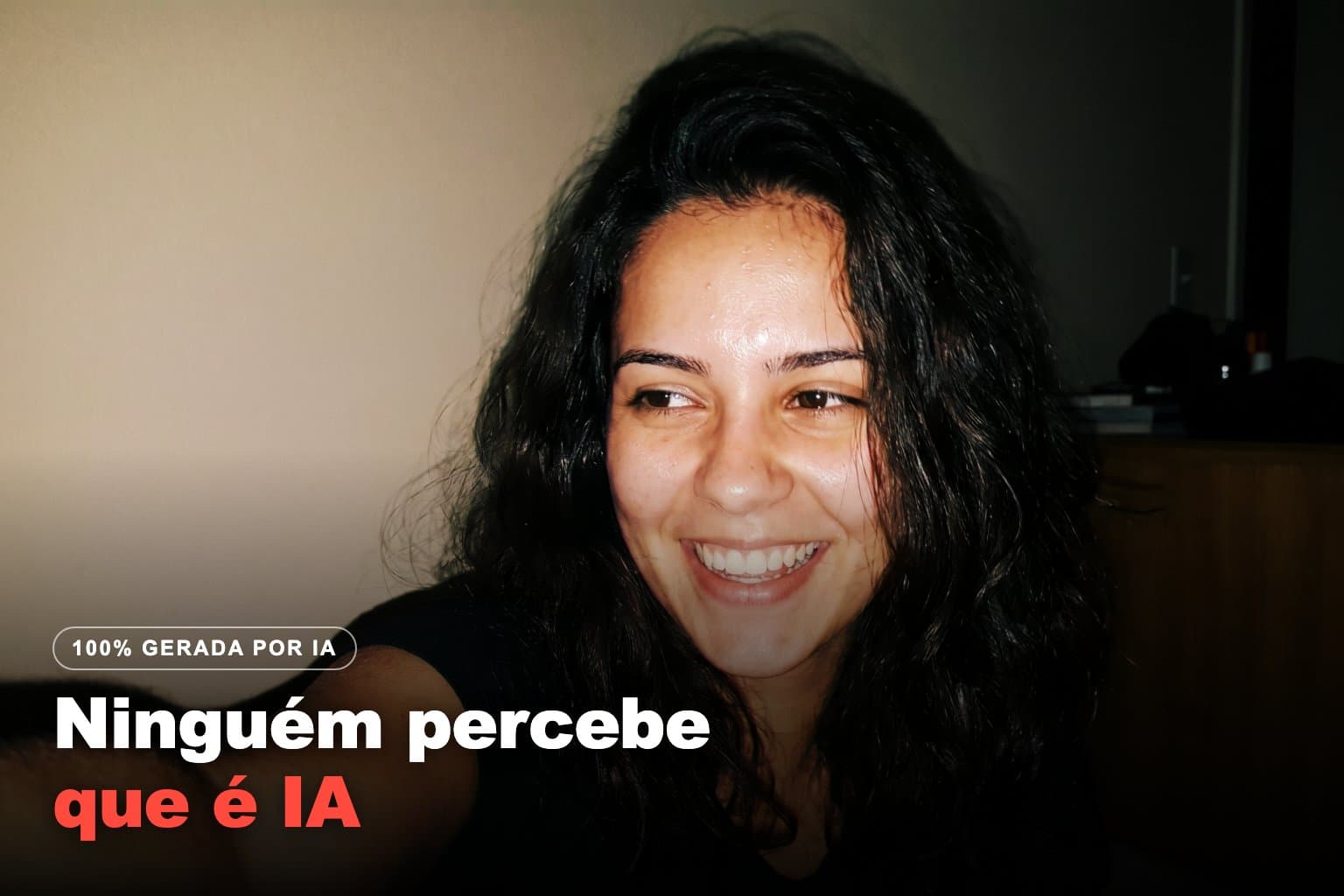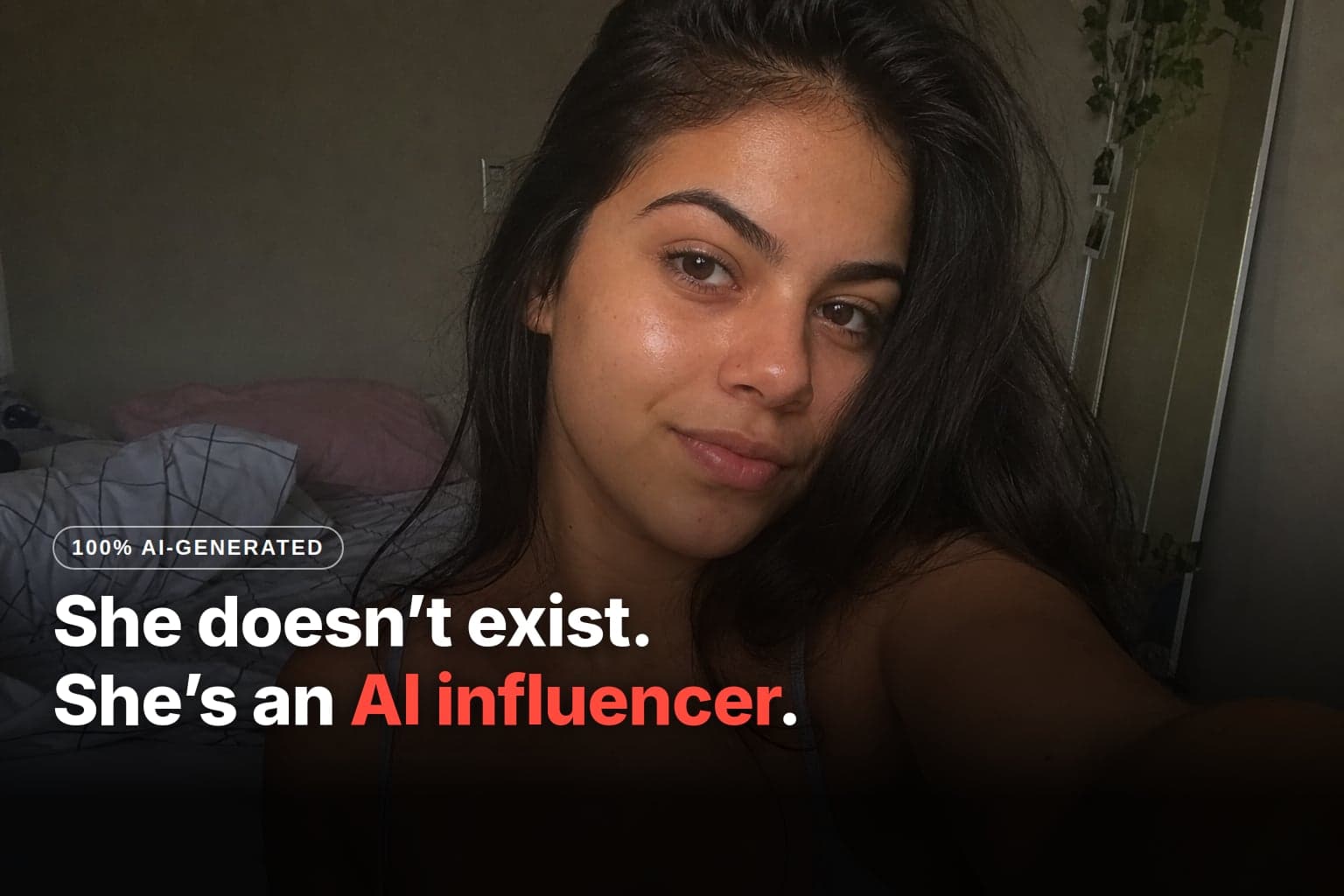
These four women don't exist. All four were generated with AI on the same day, with AI Image 6 on Avatrix, with no camera and no model. The gamer has her pink strand out of place and the purple glow of her setup on her face. The country girl has late-afternoon light rimming her hair. None of them looks like AI, and the secret wasn't asking for "8k hyper-realistic." It was the opposite.

Here's the thing: if your goal is a 100% AI influencer that nobody suspects is AI, what matters most isn't the setting. It's the face. And among the image models on Avatrix, the one that makes the most believable human face and skin is AI Image 6. That's the angle of this post: AI Image 6 is the AI for when the photo has to look like a real person taking a selfie, not a pretty render.
I actually ran this. I generated 4 new influencers with AI Image 6 (a gamer, a secretary, a country girl and a beach DJ), each with her own niche and her own casting. Then I took one of them and ran her through the 4 Avatrix models side by side to compare face realism. Every influencer in this post comes with a screenshot of the result and the raw English prompt in a code block, so you can copy and adapt it.
Everything here was generated in the account; I didn't pull examples from anywhere else. Wherever there's a photo, the prompt that made it sits right below. No promises, just the process with the proof in plain sight.
Where does this run on Avatrix?
You generate the photos in Workflow: click New creation and open the Image card. The card comes with Reference selected by default; to use AI Image 6, you switch the model right there in the picker. Before generating, you choose two things: the quality (1K, 2K or 4K) and the aspect ratio.
On aspect ratio, the same warning as the rest of the platform applies. AI Image 6 really honors three: 9:16 (portrait), 1:1 (square) and 16:9 (landscape). For a full-body influencer shot, go 9:16; for close-ups and headshots, 1:1; for a wide scene, 16:9.
Cost tip: each 1K generation with AI Image 6 costs 31 credits, more than the 18 that Reference costs, because AI Image 6 pulls in more skin and light detail to land the human look. For an influencer's face, 1K is enough: I ran all four characters at 1K · 9:16 and the texture came out right. Generation takes 90 to 130 seconds.
Now the formula. It shows up in full in the first prompt and repeats across all four; you'll recognize the pattern by the second one.
The formula for a human face that fools the eye
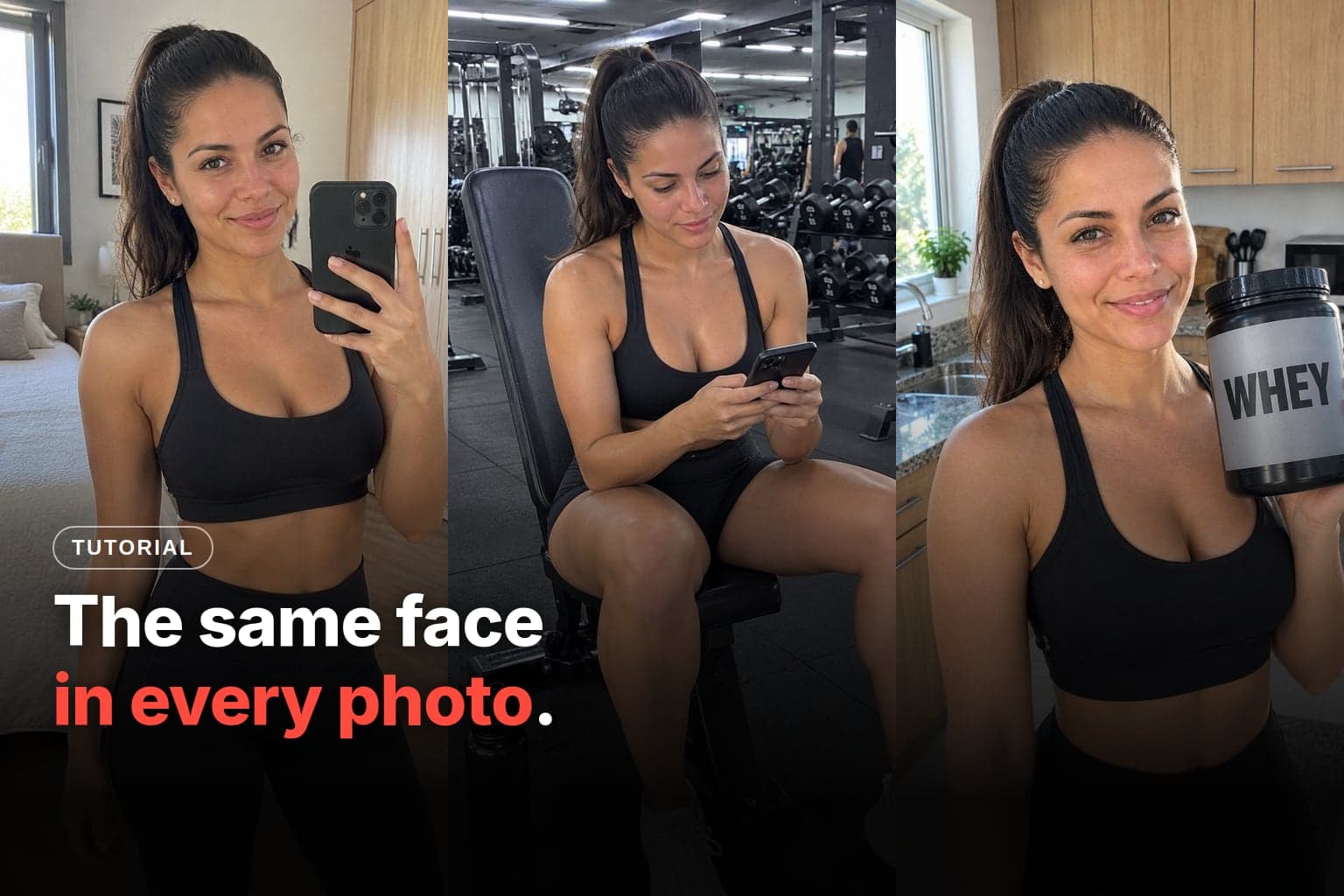
Before this run, I had generated a batch of characters that came out generic: that too-clean, too-pretty AI face that looks like anything on a stock photo site. It didn't pass as a real person. What changed everything were three pieces in the prompt, plus the negatives. It's the skeleton that repeats in the four influencers below.
- Specific casting, not a generic it-girl. Instead of "beautiful woman," you describe one memorable, slightly imperfect feature:
full asymmetric lips,a strong jaw,a small beauty mark below the right eye, plus the explicit banNOT a stock-photo face, NOT a model-agency composite, NOT symmetrical-pretty. A face that's too perfect is the first thing that gives the AI away. - Asymmetric skin imperfections. Left alone, the model drifts toward smooth, symmetrical skin. You force realism by asking for the flaw on one side only:
a freckle cluster only on the left cheek,slightly oilier T-zone,one out-of-place baby-hair flyaway,slightly chapped lower lip. The word doing the work isonly: mirrored freckles on both sides are a render's signature. - The optical fingerprint of a phone photo. A real photo isn't sharp everywhere. You reproduce the physics of the sensor:
luminance grain in the skin midtones,slight highlight clipping on the nose hotspot not smooth roll-off,micro chromatic aberration,gentle halation around the brightest light,not razor-sharp everywhere,slight focus miss on the hand. That's what makes the eye read "phone," not "studio." - The negatives that kill the tell. The end of the prompt holds the bans that strip out the AI look:
no 8k, no cinematic, no hyperrealistic, no flawless skin, no posing, no looking straight at camera, plusno mirrored symmetric freckles, no veneers, no plastic highlight roll-off, no CGI subsurface glow. Those "pretty" words are exactly what pull in the plastic sheen, so you ban all of them.
Keep this in mind. The four influencers below are this formula applied to four different niches. After that, I'll show you why AI Image 6 wins on the face against the other three models.
Naty: the gamer it-girl
This casting fools the eye because everything in the scene fits the niche without having to say "pretty gamer girl." The pink strand framing her bangs, the headset slung around her neck, the purple RGB glow hitting her skin from the side, the monitor with a match running in the background. And the detail that seals it: she's laughing sideways at her own game, caught mid-laugh, not posing for the camera. It looks like a selfie from someone with 80k followers who took it without thinking.
Casual selfie-style iPhone phone photo of a striking but believable 22-year-old Brazilian gamer it-girl you'd believe has 80k followers, fair warm-undertone skin, soft round face with a strong jaw, full asymmetric lips, expressive almond eyes with a playful sultry side-glance, heavy natural brows, dyed pink front strands framing an anime-style fringe, one memorable feature a small beauty mark below the right eye; NOT a stock-photo face, NOT a model-agency composite, NOT symmetrical-pretty. Non-uniform skin: a small freckle cluster only on the left cheek, faint redness on the nose, slightly oilier T-zone, one out-of-place baby-hair flyaway, slightly chapped lower lip, random asymmetric marks. She wears an oversized faded gaming t-shirt slipping off one shoulder, sitting at a gaming desk with an RGB-lit purple-and-pink setup, glowing monitor, headset around her neck, soft bokeh of LED strips behind. Candid unposed moment caught mid-laugh glancing to the side at the screen, genuine playful expression, lifestyle snapshot energy, not posing. Shot on iPhone front camera, mixed indoor light: cool RGB purple key from the side plus warm desk-lamp fill, uneven exposure. Optical fingerprint of a real phone photo: luminance grain in the skin midtones, slight highlight clipping on the nose hotspot not smooth roll-off, micro chromatic aberration on the RGB edges, gentle halation around the brightest LED, not razor-sharp everywhere, slight focus miss on the hand, imperfect white balance. Looks exactly like a real Brazilian gamer-girl streamer Instagram snapshot, amateur, photographic, candid. no waxy uniform skin sheen, no airbrushed cheek gradient, no mirrored symmetric freckles, no perfectly even teeth, no veneers, no smeared fused tooth row, no identical catchlight in both eyes, no plastic highlight roll-off, no over-defined eyelashes, no CGI subsurface glow, no stock-photo smile, no model-agency symmetry, no clean studio look, no 8k, no cinematic, no hyperrealistic, no flawless skin, no posing, no looking straight at cameraAI Image 6 · 1K · 9:16.
Camila: the discreet secretary
Here the casting is all about contrast, the "secretary with a secret" idea. The slightly unbuttoned white office shirt, the pencil skirt, the thin-framed glasses, the low bun with a few strands escaping. And the setting that anchors it as a real photo: a mirror selfie in a real home bathroom, with window light from the side, fingerprint smudges on the mirror and a few skincare bottles on the counter. The restrained half-smile, glancing off to the side and away from the camera, gives it the feel of a photo she sent to someone, not to a feed.

Casual mirror selfie iPhone phone photo of a striking but believable 28-year-old Brazilian woman you'd believe has 80k followers, an elegant discreet-secretary-with-a-secret vibe, medium-fair warm-undertone skin, refined defined jawline, full asymmetric lips, expressive almond eyes with a slightly tired sultry lid behind thin clear glasses, heavy natural brows, dark hair in a loose low bun with a few escaping strands, one memorable feature a small mole near the jaw; NOT a stock-photo face, NOT a model-agency composite, NOT symmetrical-pretty. Non-uniform skin: a freckle cluster only on the left cheekbone, faint under-eye darkness, slightly oilier T-zone, one out-of-place flyaway, slightly chapped lip, random asymmetric marks. She wears a slightly unbuttoned white office shirt and a pencil skirt, holding her phone in a real home bathroom mirror with soft daylight, a couple of skincare bottles and slight clutter on the counter. Candid unposed moment, contained provocative half-smile looking just off-camera, lifestyle snapshot energy, not posing. Shot on iPhone, soft window daylight from camera left, fingerprint smudges on the mirror. Optical fingerprint of a real phone photo: luminance grain in the skin midtones, slight highlight clipping on the forehead not smooth roll-off, micro chromatic aberration on bright edges, gentle halation around the window highlight, not razor-sharp everywhere, slight focus miss, imperfect warm white balance. Looks exactly like a real Brazilian Instagram mirror selfie, amateur, photographic, candid. no waxy uniform skin sheen, no airbrushed cheek gradient, no mirrored symmetric freckles, no perfectly even teeth, no veneers, no smeared fused tooth row, no identical catchlight in both eyes, no plastic highlight roll-off, no over-defined eyelashes, no CGI subsurface glow, no stock-photo smile, no model-agency symmetry, no clean studio look, no 8k, no cinematic, no hyperrealistic, no flawless skin, no posingAI Image 6 · 1K · 9:16.
Antonella: the country it-girl
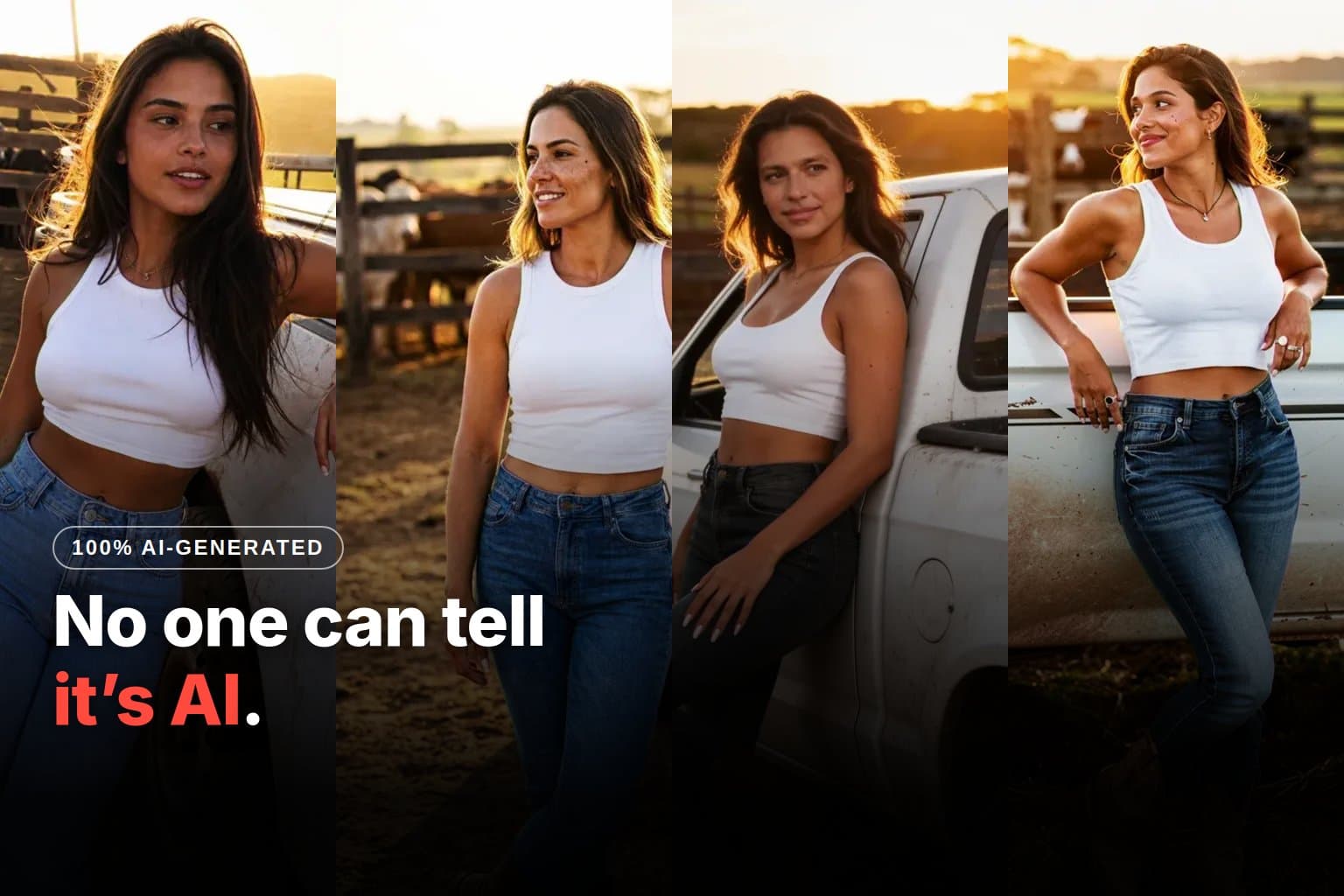
This is the influencer I ran the most; she became my test subject for comparing the models later. The country niche has a look of its own: white crop top, high-waisted jeans, cowboy boots, leaning on a dusty pickup with the fence and cattle blurred behind her. What seals the realism is the light: a single low late-afternoon backlight coming from behind, wrapping her hair and letting the other side fall into ambient shadow. No flat studio light here: it's the dirty, warm light of the countryside at the end of the day. And she's caught mid-step, looking out of frame, with a spontaneous half-smile.

Casual full-body iPhone phone photo of a striking but believable 24-year-old Brazilian agro it-girl you'd believe has 80k followers, sun-kissed tanned skin, strong defined jawline, full slightly asymmetric lips, expressive almond brown eyes with a slightly sultry lid, heavy natural brows, one memorable feature a small beauty mark on the left cheekbone, a full natural hourglass figure with a real waist-to-hip; NOT a stock-photo face, NOT a model-agency composite, NOT symmetrical-pretty. Non-uniform skin: a small freckle cluster only on the left cheekbone (asymmetric, not mirrored), faint tan lines, slightly oilier reddish T-zone versus matte cheeks, one out-of-place baby-hair flyaway, slightly chapped lower lip, random asymmetric marks. She wears a cropped white tank top, high-waisted jeans and worn brown texan boots, long manicured nails, leaning casually against a dusty white pickup truck on a Brazilian farm at late golden hour, wooden fence and cattle softly blurred behind, dry warm countryside light. Candid unposed moment caught mid-step glancing off-frame, genuine spontaneous half-smile, lifestyle snapshot energy, not posing. Shot on iPhone, single low golden-hour backlight from behind, warm rim wrapping the hair, opposite side falling into ambient-only cool shadow. Optical fingerprint of a real phone photo: luminance grain in the skin midtones, slight highlight clipping on the nose and forehead hotspots not smooth roll-off, micro chromatic aberration on backlit hair edges, gentle halation around the brightest specular, not razor-sharp everywhere, slight focus miss on the hand, imperfect warm white balance. Looks exactly like a real Brazilian agro influencer Instagram snapshot, amateur, photographic, candid. no waxy uniform skin sheen, no airbrushed cheek gradient, no mirrored symmetric freckles, no perfectly even teeth, no veneers, no smeared fused tooth row, no identical catchlight in both eyes, no plastic highlight roll-off, no over-defined eyelashes, no CGI subsurface glow, no stock-photo smile, no model-agency symmetry, no floating perfect bokeh balls, no clean studio look, no 8k, no cinematic, no hyperrealistic, no flawless skin, no looking at camera, no posingAI Image 6 · 1K · 9:16.
Lola: the beach DJ
The last one is the hardest to make believable, because it's the busiest scene: a beach party at sunset, neon, a blurred crowd behind her, warm backlight from the sun dropping into the ocean. Any crowded scene like this tends to melt with AI. What holds it together is naming the light mix: the warm sunset backlight plus colored neon spill, with uneven exposure and a slight flare. She's in a bikini under an open beach shirt, drink in hand, turning mid-laugh toward someone out of frame. The sweat shining on the high points of her skin and the wet strand across her face are what say "real party photo," not "photo shoot."

Candid phone photo of a striking but believable 26-year-old Brazilian beach-party it-girl you'd believe has 80k followers, sun-kissed tanned skin, defined jaw, full asymmetric lips, expressive almond eyes with a sultry come-with-me side glance, heavy natural brows, long dark wet-look beach hair, one memorable feature a small beauty mark on the cheekbone; NOT a stock-photo face, NOT a model-agency composite, NOT symmetrical-pretty. Non-uniform skin: a freckle cluster only on the left shoulder and cheek, faint tan lines, a real sweat sheen on the high points, one out-of-place wet strand across the face, slightly chapped lip, random asymmetric marks. She wears a simple bikini top under an open beach shirt and shorts, holding a drink, on a wooden seaside deck at a sunset beach party, neon string lights and a blurred crowd behind, ocean and golden-pink dusk sky. Candid unposed moment caught mid-turn laughing toward someone off-frame, genuine spontaneous expression, lifestyle snapshot energy, not posing. Shot on iPhone, warm low sunset backlight plus colored neon spill, uneven exposure, mild lens flare. Optical fingerprint of a real phone photo: luminance grain in the skin midtones, slight highlight clipping on the wet-skin hotspots not smooth roll-off, micro chromatic aberration on the neon edges, gentle halation around the brightest light, not razor-sharp everywhere, slight motion blur on the hand, imperfect warm white balance. Looks exactly like a real Brazilian beach-night influencer Instagram snapshot, amateur, photographic, candid. no waxy uniform skin sheen, no airbrushed cheek gradient, no mirrored symmetric freckles, no perfectly even teeth, no veneers, no smeared fused tooth row, no identical catchlight in both eyes, no plastic highlight roll-off, no over-defined eyelashes, no CGI subsurface glow, no stock-photo smile, no model-agency symmetry, no clean studio look, no 8k, no cinematic, no hyperrealistic, no flawless skin, no posingAI Image 6 · 1K · 9:16.
Why AI Image 6 wins on the human face (I tested all 4 models)
Here's the test behind the title. I took Antonella, the country it-girl, and ran the exact same character, with the same prompt formula, through four image models on Avatrix: AI Image 6, Reference, Creative and AI Image 9. Same influencer, same scene, four engines. The question was simple: which one makes the face and skin most believable as a real person?
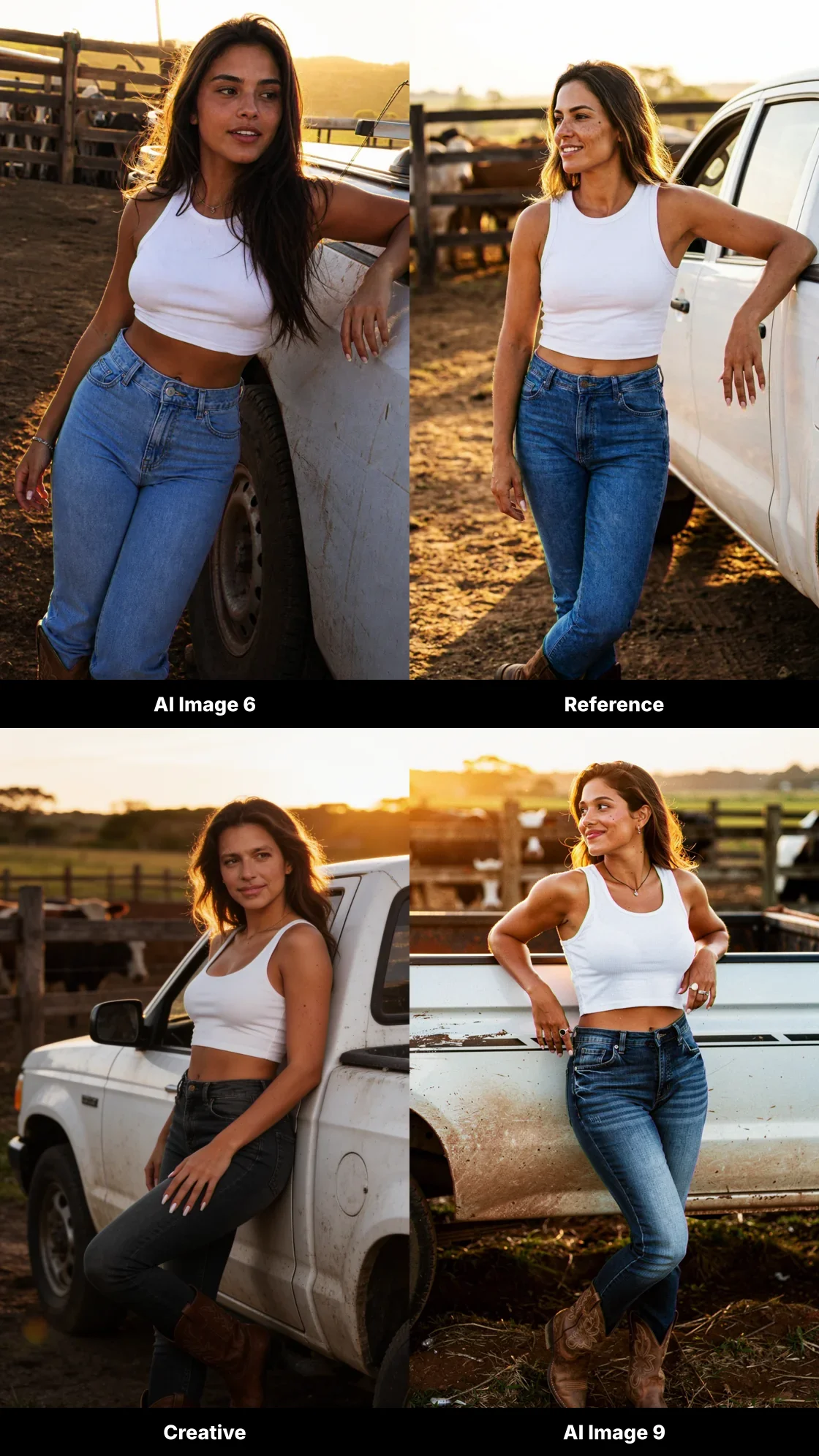
Same influencer, 4 Avatrix models, left to right · AI Image 6, Reference, Creative, AI Image 9.
Here's my ranking for human face realism, comparing the skin on all four up close:
- AI Image 6: the most human. It delivered the most convincing real-phone-photo look: grain in the skin, a candid mid-step moment, texture and oiliness in the right places, that "not quite perfect" quality the brain reads as a real person. It's the one I'd pick for an influencer who has to pass as a real person in a selfie.
- Creative: second, and strong on scenes. Good skin, a believable face, and its edge shows up in complex scenes and in resolution: Creative generates native 2K. The face has a touch more "catalog model" than AI Image 6, but it's an easy second choice for realism.
- AI Image 9: the most editorial. Beautiful, but the most "magazine." The golden light came out more stylized and the pose looked more like a fashion campaign. If you want an aspirational portfolio shot, this is the one. If you want it to look like a selfie someone texted a friend, it gives itself away as a production.
- Reference: the cleanest, and the king of consistency. On the raw face it came out the cleanest of the four: slightly smoother skin, less of the "grit" of a real photo. But it holds the advantage that changes the game: Reference is the best at keeping the same face photo after photo using a reference image. And that's gold for a whole feed.
I'll be honest about the trade-off, because it decides which model you use: AI Image 6 wins on raw face realism, the first photo that makes the person look real. Reference wins on identity consistency, keeping that same face across fifty photos without it drifting.
So what works in practice is combining the two. You generate your influencer's base face with AI Image 6, the most human one, the one that will fool the eye. Then you use that image as the reference photo in the Reference model to produce the rest of the feed with the identity locked. How reference-based consistency works in the Reference model, with ready-to-use prompts, is in the guide to realistic photos with Reference.
So you don't have to memorize it, here's which Avatrix model to reach for, and when.
| Model | What to use it for |
|---|---|
| AI Image 6 | The most realistic human face: the base photo that fools the eye. Your influencer in a selfie that passes as a real person. |
| Reference | Keeping the same face photo after photo, using a reference. A whole feed with a single identity. |
| Creative | Busier scenes and native 2K generation, when the setting matters more than the close-up. |
| AI Image 9 | A more editorial, magazine-cover look, when you want less "selfie" and more "photo shoot." |
The mistakes that give away your AI influencer
After generating the four characters and comparing the four models, these are the slip-ups that hurt face realism the most:
- Asking for "8k cinematic hyper-realistic." It's mistake number one, and on a human face it's fatal. Those words pull in waxy skin and a doll-like sheen. Describe the look of a phone photo, not a quality adjective.
- A generic it-girl. If you don't give her one memorable, slightly imperfect feature, you get that pretty stock-photo face that doesn't pass as a person. Specific casting is what separates a "real influencer" from a "stock model."
- Mirrored freckles on both sides. Symmetrical imperfection is a render's signature. Ask for the flaw on one side only:
only on the left cheek. Asymmetry is what reads as human. - A face that's too perfect. Without
not symmetrical-prettyand the skin negatives (no flawless skin, no plastic highlight roll-off, no CGI subsurface glow), AI Image 6 also slides toward smooth. Flawed skin is what fools the eye. - Staring straight into the camera, posing. A static pose and eyes on the lens scream "produced photo." Ask for a caught-in-the-moment shot (
mid-laugh,mid-step,looking off-frame) and banposingandlooking straight at camera. - Trying to build a whole feed on AI Image 6 alone. It's the best for the base face, but it's not where you lock the identity at scale. To keep the same face across many photos, take the reference photo to the Reference model.
Start creating your AI influencer
Open the Image card in Workflow, switch the model to AI Image 6, pick the quality and one of the three aspect ratios, and build the prompt from the three pieces (specific casting, asymmetric skin imperfections and the look of a phone photo) plus the negatives. The face comes out human. To repeat that face across a whole feed, hand the reference photo to the Reference model.
There are 5,674 creators on the platform, which runs AI Image 6, Reference and the rest of the stack (AI Video 1, AI Video 7, Creative). You can follow this same path with the interface in English and 15+ tools in a single account:
Frequently asked questions
What's the most realistic AI model for creating an influencer?
For human face and skin realism, AI Image 6 was the most believable in my test across the four Avatrix models: it delivers the look of a real phone photo, with grain, texture and a candid feel. The Reference model wins when you need to keep the same face across many photos with a reference image. What works is generating the base face with AI Image 6 and locking the identity in Reference.
Why does my AI influencer look like AI?
Almost always because the prompt asks for "8k," "cinematic" or "flawless," or because the casting is too generic: a pretty stock-photo face, mirrored freckles on both sides, a straight-on pose for the camera. The fix is the opposite: one memorable, slightly imperfect feature, skin imperfections on one side only, the look of a phone photo (grain, not sharp everywhere) and the negatives against plastic skin.
How much does it cost to generate a photo with AI Image 6 on Avatrix?
Each 1K generation with AI Image 6 costs 31 credits, more than the 18 that Reference costs, because it pulls in more skin and light detail to land the face's realism. For an influencer's face, 1K already gives the right texture. Generation takes 90 to 130 seconds.
Can I keep the same influencer face across several photos with AI Image 6?
AI Image 6 is the best for generating the most human base face, but what holds the identity photo after photo is the Reference model with a reference image: you attach the face's anchor image and it edits on top of it. What works is generating the face with AI Image 6 and producing the feed in Reference while keeping the reference image. The step-by-step for reference-based consistency is in the Reference model guide.
AI Image 6 or Reference: which one should I use?
It depends on what you need at that moment. AI Image 6 for the base face and for photos where human skin realism matters most: it's the most believable. Reference for keeping that face consistent across a whole feed with a reference image, and for product photos and scenes with label text. In practice you use both: generate the face with AI Image 6, then replicate it in Reference.
What aspect ratios does AI Image 6 on Avatrix support?
In practice, three: 9:16 (portrait, for full-body influencer shots), 1:1 (square, for close-ups and headshots) and 16:9 (landscape, for wide scenes). I ran all four characters at 9:16, which is the feed and stories ratio.